Bright Beats Anatomy and Physiology · Study Sheet
The Human Body: Levels of Organization, Life Functions and Homeostasis
Body Basics · Video code HB1
 Scan to watch
Anatomy and physiology, body basics. The human body: levels of organization, life functions and homeostasis.
How is the body built, what does it need to stay alive, and how does it keep itself steady?
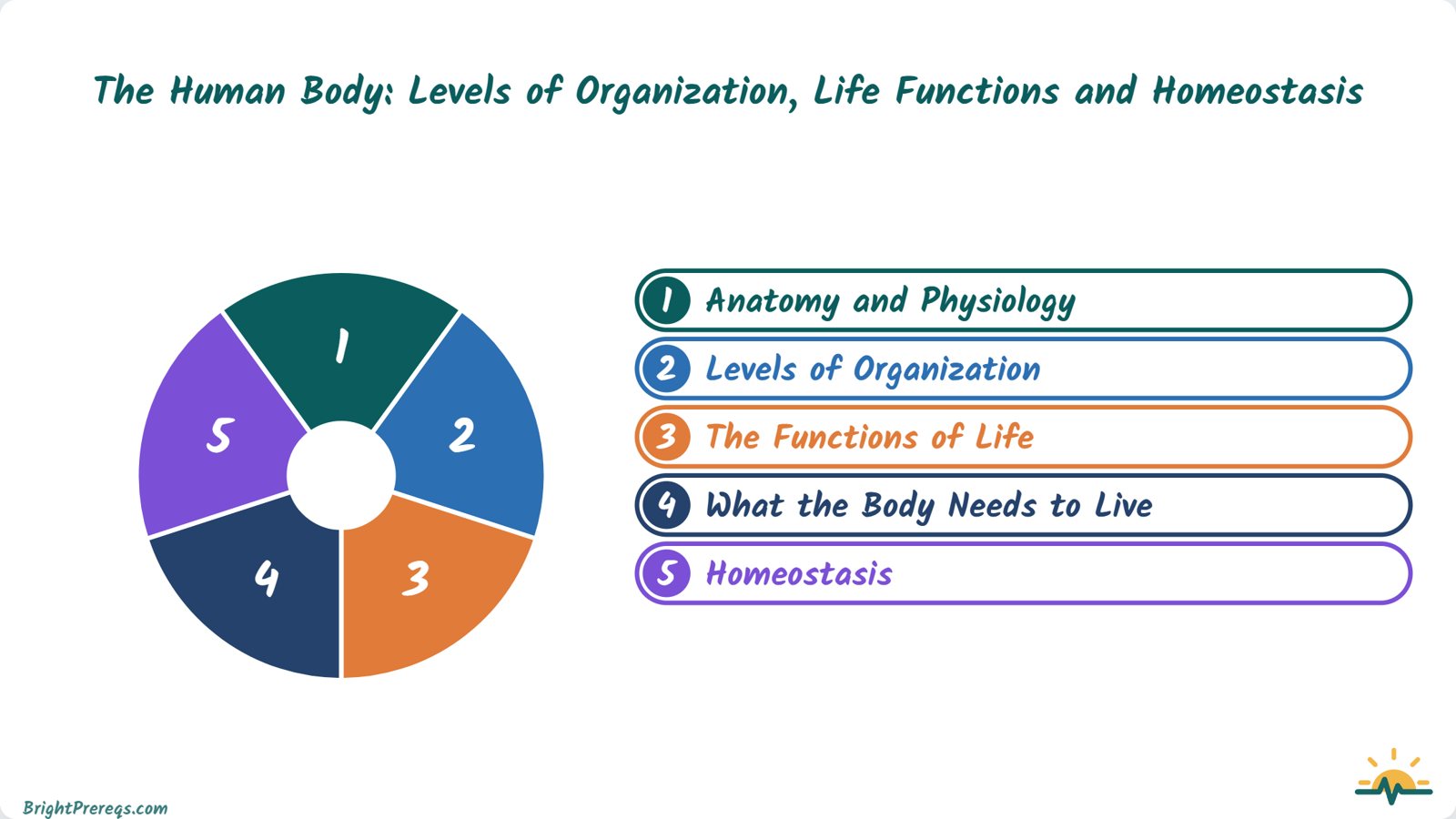
Five parts follow: anatomy and physiology; levels of organization; the functions of life; what the body needs to live; and homeostasis.
Part 1: anatomy and physiology, the body's structures and how they work.
The study of the body's structures is called anatomy. The word comes from a Greek root that means "to cut apart."
Some structures are large enough to see, measure and weigh. Others are so small they can only be seen with a microscope.
Studying the large structures you can see is gross anatomy. Studying structures seen only with a microscope is microscopic anatomy.
The microscopic side includes cytology, the study of cells, and histology, the study of tissues.
Anatomy can be studied by region, such as everything in the abdomen. Or it can be studied by system, such as all the skeletal muscles of the body.
The other half, physiology, is about function. It studies how the body's structures work together to support life.
Much of physiology centers on homeostasis, the steady inside conditions that living things keep.
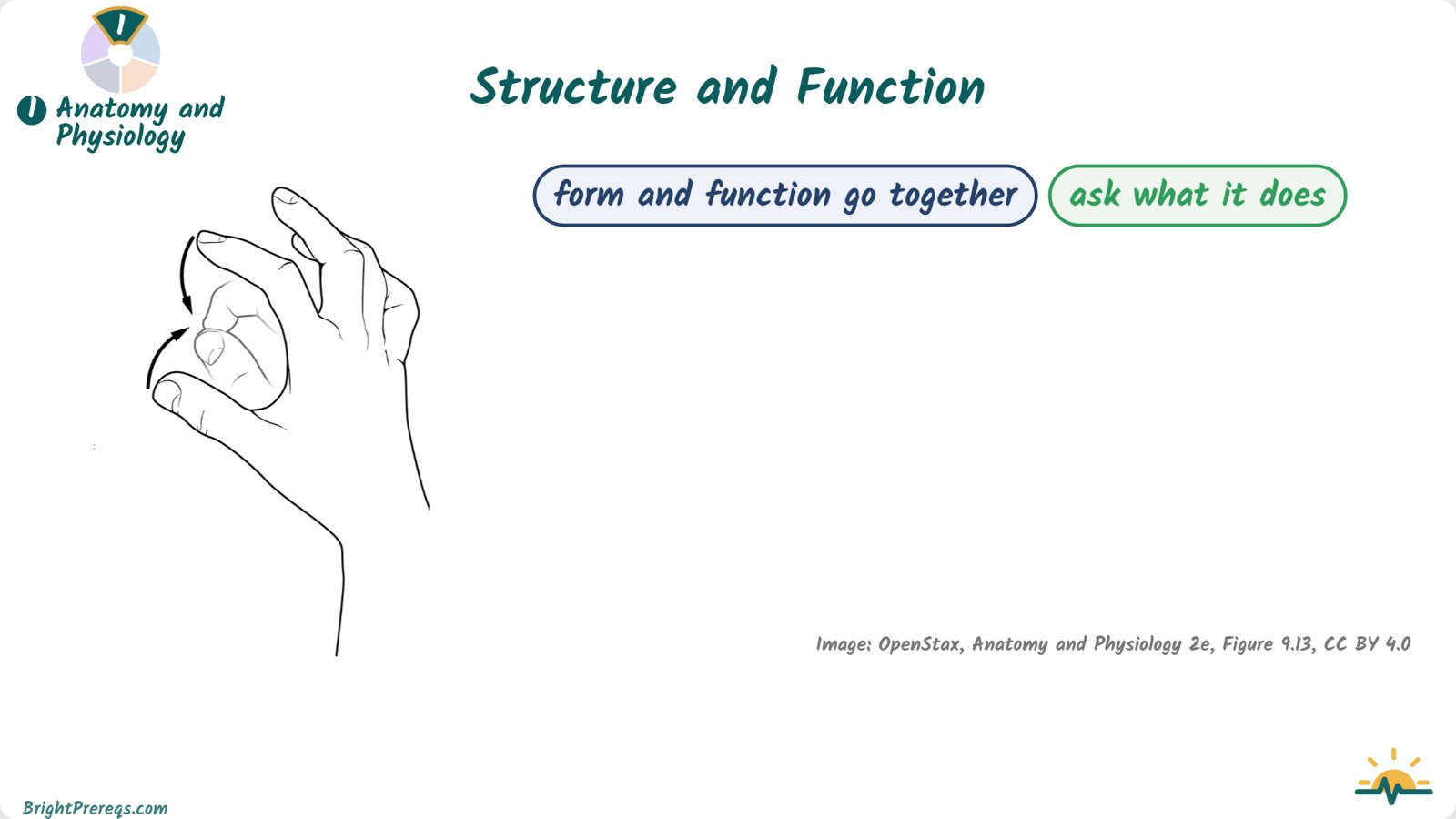
Form and function go together. The thin flap of the eyelid can snap down to clear away dust, then slide back up so you can see.
The hand is another example. The thumb sits opposite the four fingers, so the hand can pinch and grasp. So when you learn a structure, ask what it does.
Part 2: levels of organization, how the body is built.
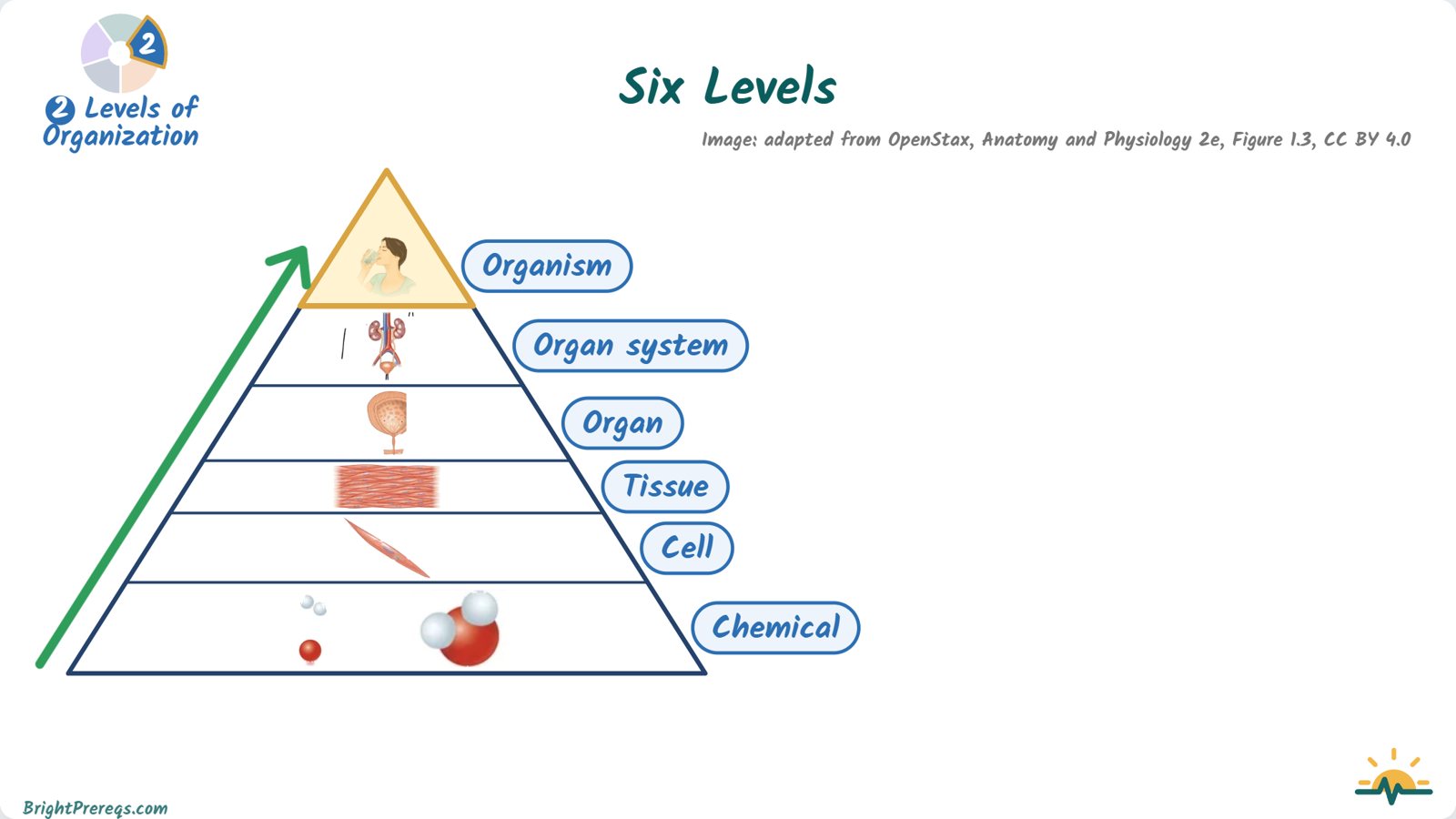
The body is built in six levels, from the smallest to the largest: chemical, cell, tissue, organ, organ system and organism.
The chemical level is the base. An atom is the smallest unit of an element, such as oxygen, carbon or calcium.
Atoms join to form molecules, such as water, proteins and sugars. Molecules are the building blocks of every body structure.
One level up is the cell, the smallest unit that can work on its own. Almost every job in the body is done by cells, or started by them.
Inside a cell, a flexible membrane holds cytoplasm, a watery fluid, and tiny working parts called organelles.
One level up, a tissue is a group of similar cells working together on one job. Next, an organ is made of two or more types of tissue.
Next, an organ system is a group of organs working together. The kidneys, ureters, bladder and urethra together make the urinary system.
At the top is the organism, a whole living being that can do everything needed for life on its own. Chemical, cell, tissue, organ, organ system, organism: each level is built from the one below it.
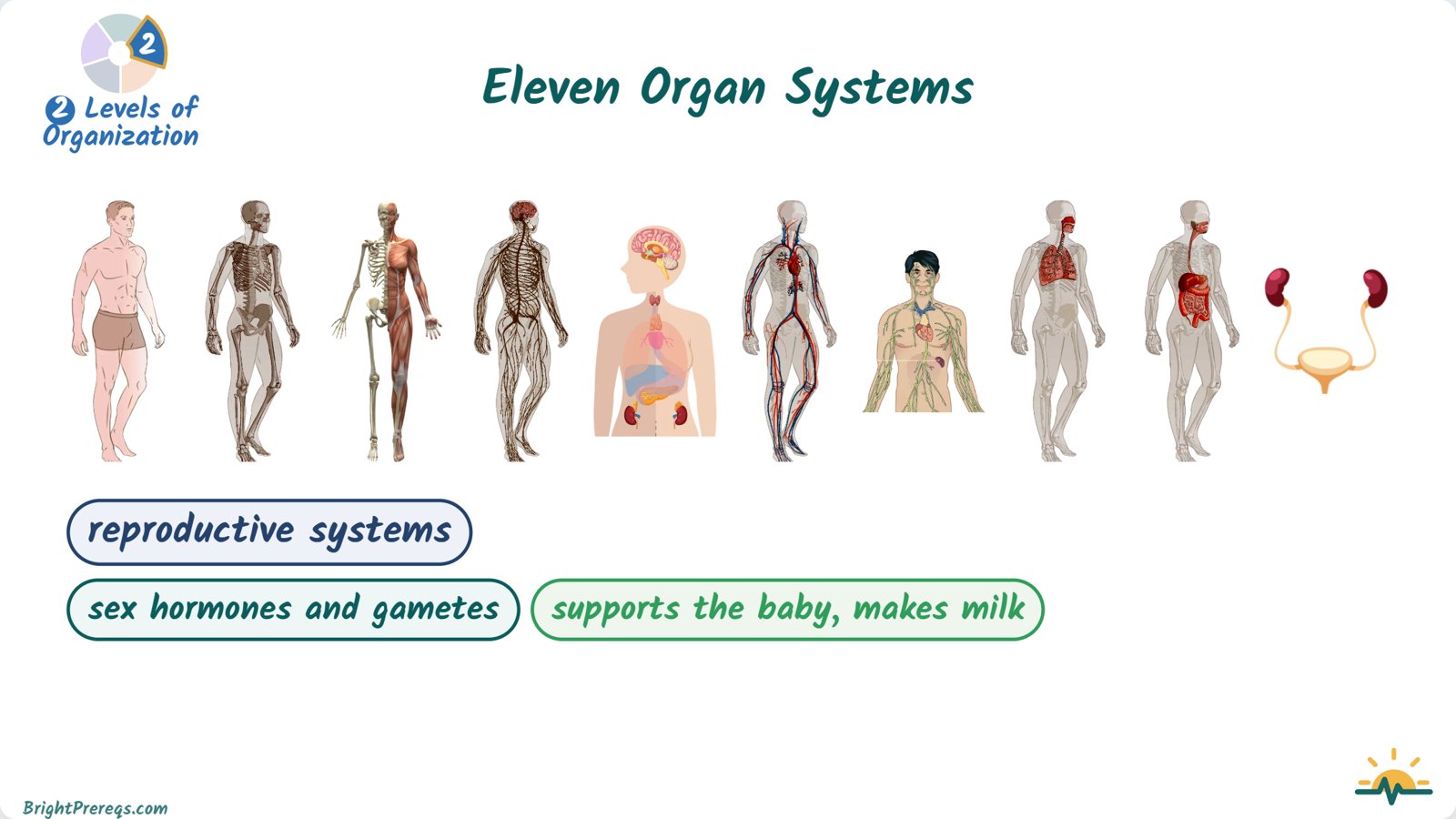
The human body has eleven organ systems. Most organs work in more than one system.
Three systems cover, support and move the body. The integumentary system is the skin, hair and nails. It encloses the body's inside structures and holds many sensory receptors.
The skeletal system is the bones, cartilage and joints. It supports the body and, with the muscles, makes movement possible.
The muscular system is the skeletal muscles and tendons. It moves the body and helps keep body temperature.
Two systems control the body. The nervous system is the brain, spinal cord and nerves. It picks up sensory information, makes sense of it, and starts the body's responses.
The endocrine system is made of glands, such as the pituitary, thyroid, pancreas and adrenal glands. They release hormones that control body processes.
Two systems carry fluid around the body. The cardiovascular system is the heart and blood vessels. It delivers oxygen and nutrients to the tissues and evens out temperature in the body.
The lymphatic system is the thymus, lymph nodes, spleen and lymphatic vessels. It returns fluid to the blood and defends against pathogens, the germs that cause disease.
Three systems take things in and clear wastes out. The respiratory system is the nasal passages, trachea and lungs. It brings oxygen into the blood and removes carbon dioxide.
The digestive system is the stomach, liver, gallbladder and intestines. It processes food for the body and removes wastes from undigested food.
The urinary system is the kidneys and bladder. It controls the body's water balance and removes wastes from the blood.
Last are the male and female reproductive systems. Both make sex hormones and sex cells, called gametes. The female system also supports the baby until birth and makes milk. Cover and move, control, carry, take in and clear out, and reproduce: eleven systems.
Part 3: the functions of life, what the built body does to stay alive.
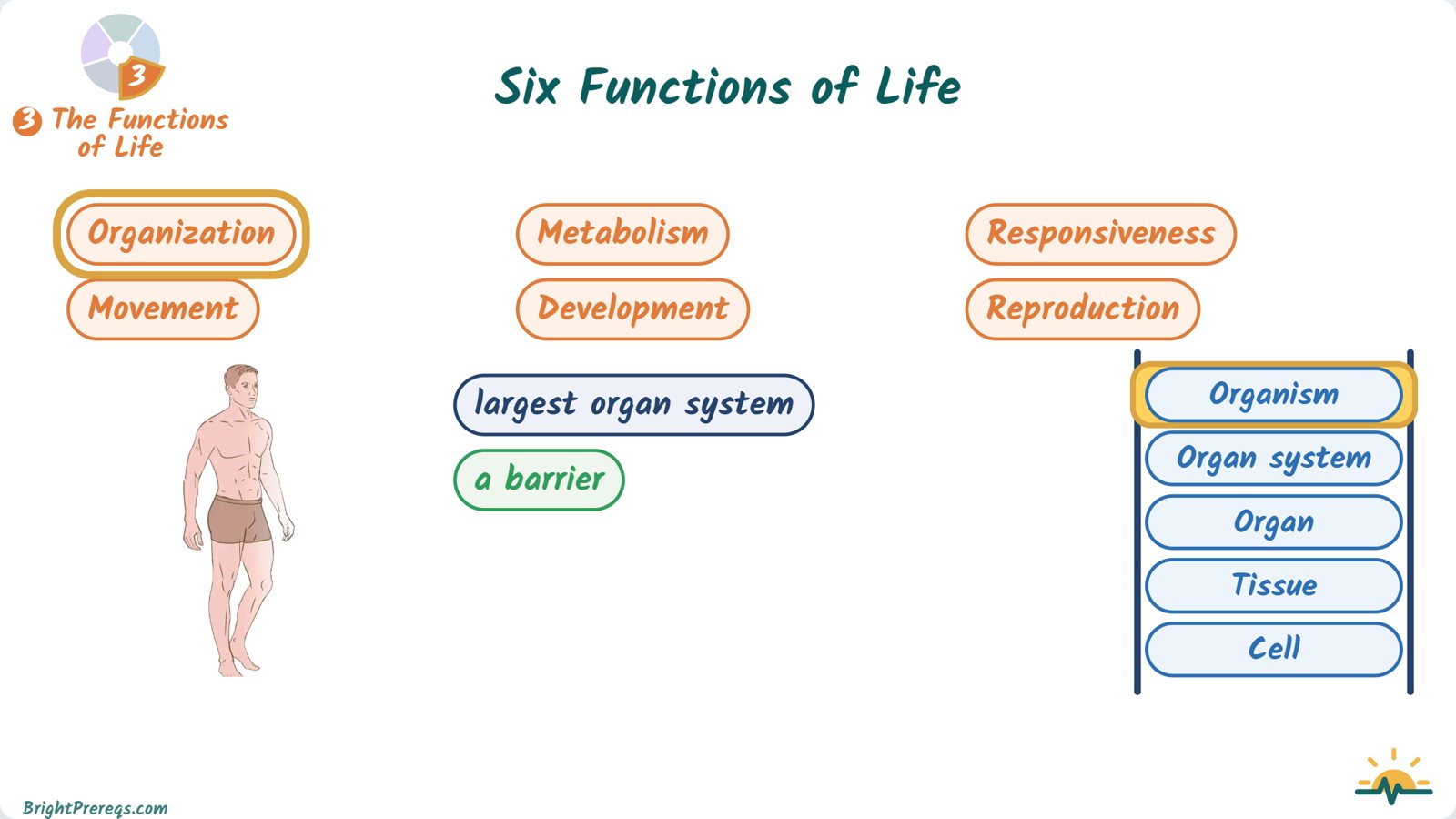
Six functions mark human life: organization, metabolism, responsiveness, movement, development and reproduction.
Organization means keeping things in their own compartments, level by level, from the cell up to the whole body. The body's trillions of cells are kept moist and fed, and apart from outside threats.
At the cell level, a cell membrane keeps each cell's inside apart from the fluid around it. At the tissue and organ levels, sheaths wrap nerves and muscles, and membranes keep the lungs, heart and kidneys apart.
At the organ system level, blood vessels keep the blood inside a closed system. And the gut is a passage open to the outside, so its bacteria, more than all the body's own cells, are outside the body. They must not circulate freely inside it.
At the level of the whole organism, the body's largest organ system is the integumentary system. The skin is a barrier against harmful microorganisms and toxins. From the cell membrane to the skin, every level keeps its own compartment.
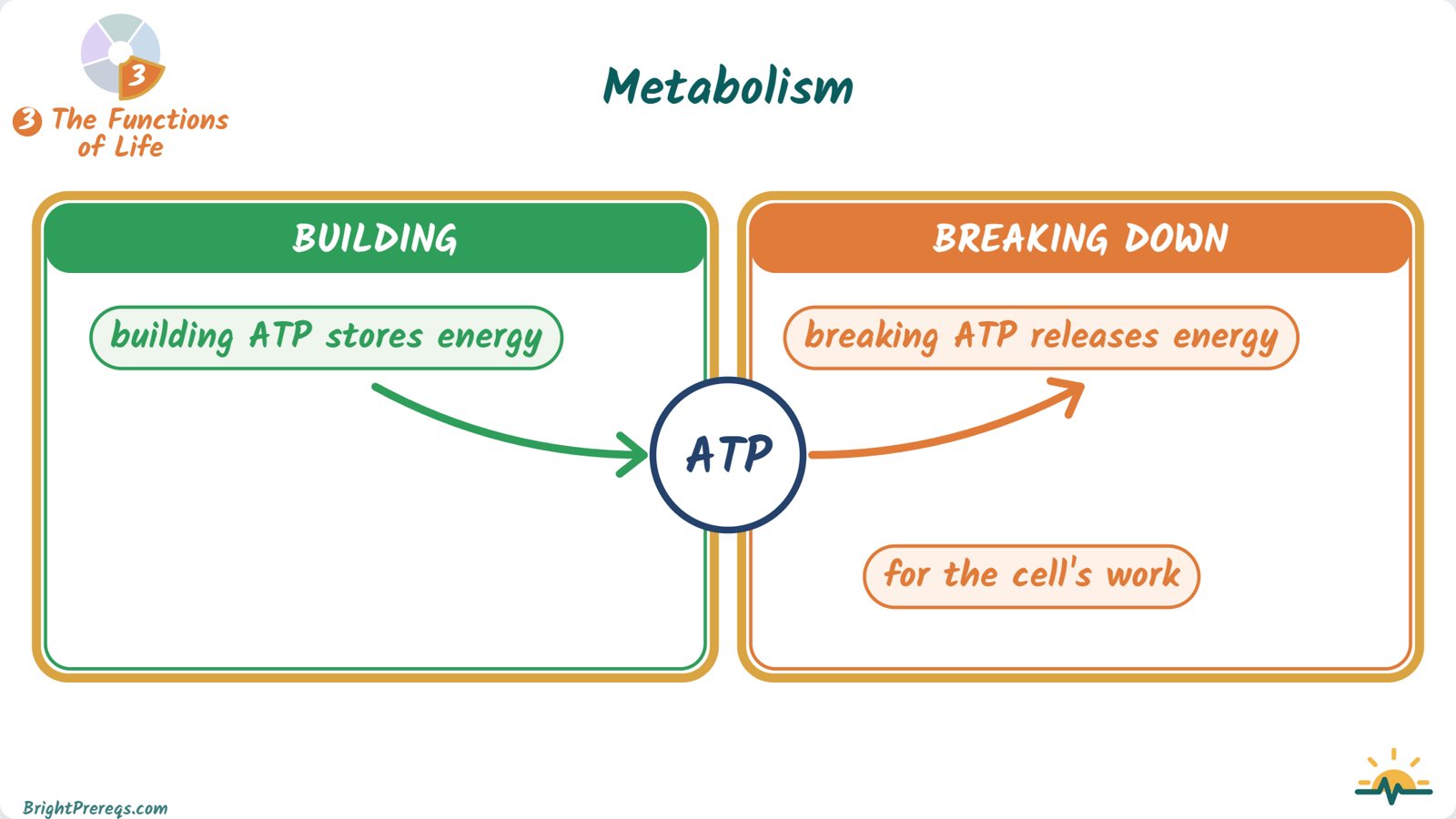
All the body's chemical reactions together are called metabolism. It has two sides: building up and breaking down.
Building up is called anabolism. Small, simple molecules join into large, complex ones, and that uses energy.
Breaking down is called catabolism. Large, complex molecules, such as those in food, are broken into small, simple ones, and that releases energy. Breaking food down gives the body the parts and the energy it builds with.
Both happen at the same time, all the time, to keep you alive.
Every cell stores energy by building a molecule called adenosine triphosphate, or ATP, and moves it to where energy is needed. Breaking the ATP down releases that energy for the cell's work.
The third function is responsiveness: the body adjusts to changes inside and outside it, such as moving toward food and water, and away from danger.
When body temperature rises, the body sweats, and the blood vessels in the skin widen. Both help cool the body down.
The fourth function, movement, is more than walking. Blood cells travel through the body, and muscles hold the posture. Muscle groups move air in and out of the lungs, and push the blood around.
The fifth function, development, is all the changes the body goes through in life. In one of them, differentiation, plain cells become specialized for certain jobs.
Growth is an increase in body size: more cells, more material around the cells, such as minerals in bone, and, only a little, bigger cells.
The sixth function, reproduction, forms a new person from the parents. Without it, the line of life would end, because death comes to every complex living thing. Organization, metabolism, responsiveness, movement, development and reproduction: the six functions of life.
Part 4: what the body needs to live, to carry out those functions.
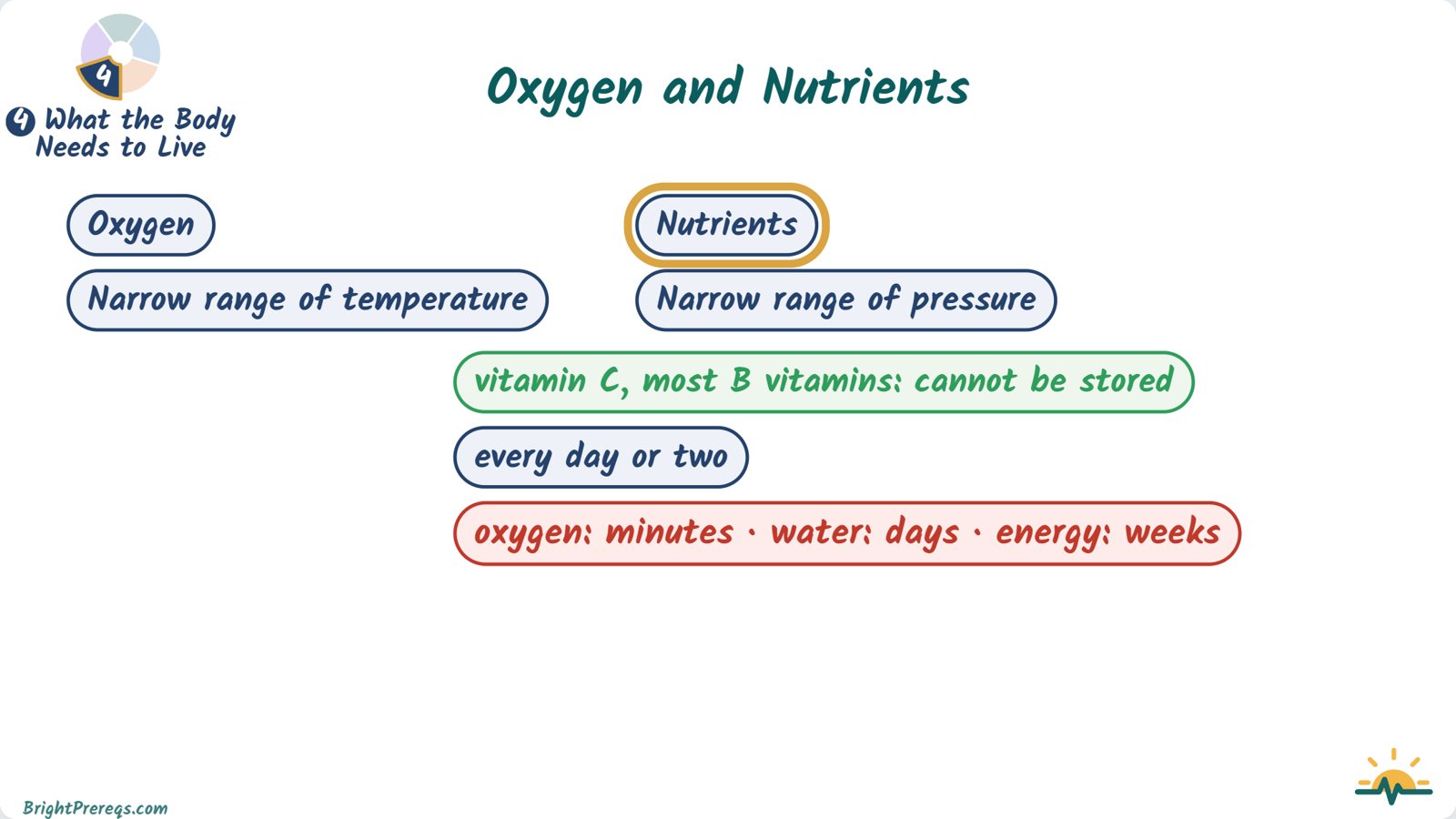
The body needs four things: oxygen, nutrients, a narrow range of temperature, and a narrow range of pressure.
First, oxygen. Air is only about 20 percent oxygen, but the body needs that oxygen to make ATP.
Brain cells are especially sensitive to a lack of oxygen, because they need a high, steady supply of ATP. Without oxygen, brain damage is likely within five minutes, and death within ten minutes.
Second, nutrients: the things in food and drink the body must have. There are three classes: water, the energy-giving and body-building nutrients, and the vitamins and minerals.
Water is the most critical nutrient. The body's chemicals are dissolved and carried in water, and the chemical reactions of life take place in it. A person may survive only a few days without it.
Water makes up about 70 percent of an adult's body mass. It helps control body temperature, and it cushions and protects the joints.
Next, carbohydrates and lipids, the fats, give energy: the body turns their broken-down parts into ATP. Proteins give amino acids, the building blocks of the body. A person can live at least several weeks without the energy-giving nutrients.
Last, vitamin C and most B vitamins dissolve in water and cannot be stored. They are needed every day or two. Without oxygen, minutes. Without water, days. Without the energy-giving nutrients, weeks.
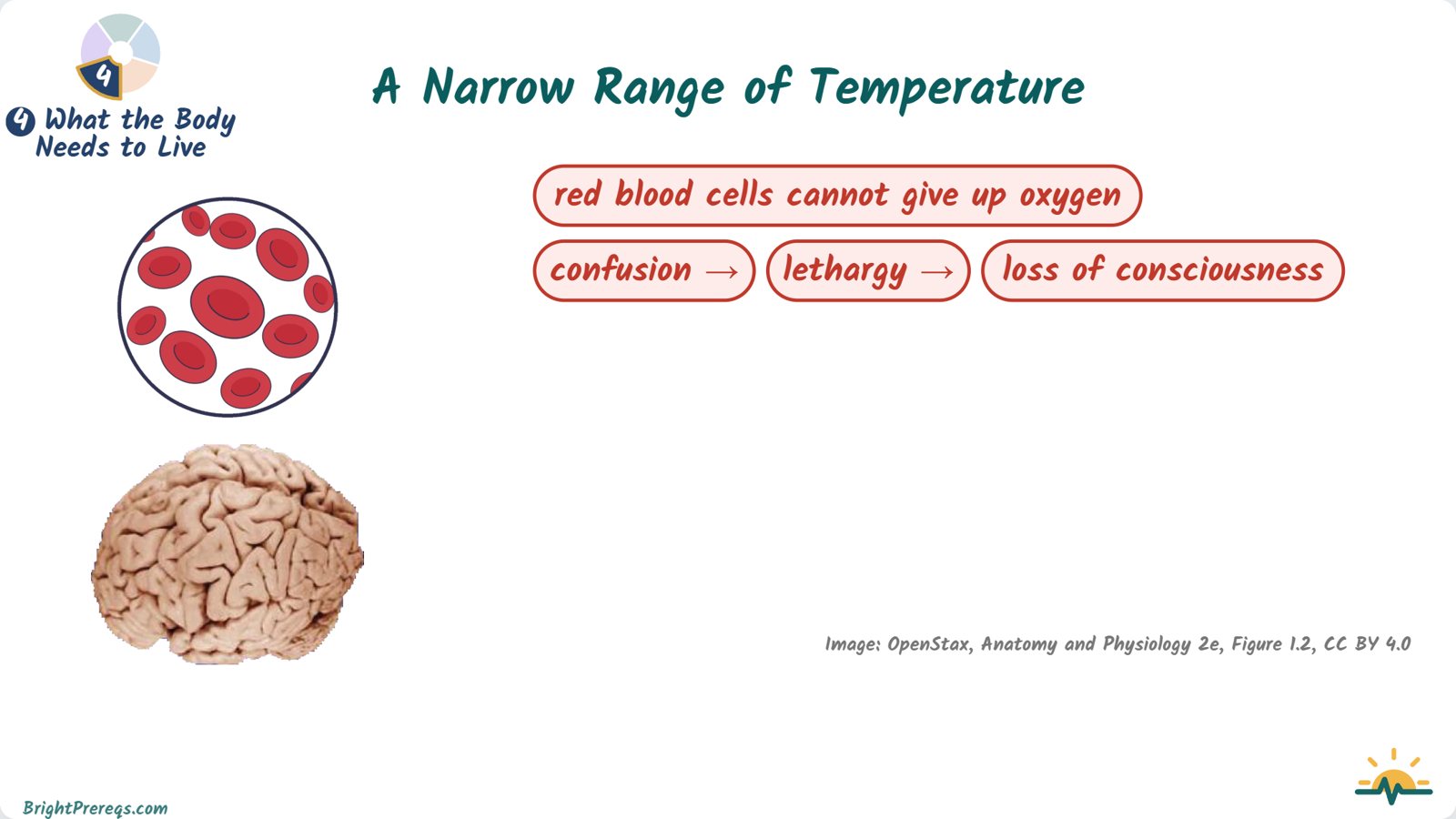
The third need is a narrow range of temperature. The body's chemical reactions work only from just below to just above 37 degrees Celsius, or 98.6 degrees Fahrenheit.
Far above or below that, enzymes, the proteins that help chemical reactions happen, lose their shape and stop working. Metabolism cannot go on.
In the heat, the body sweats. As sweat dries off the skin, it carries heat away. The body needs enough water to make that sweat.
In humid air, sweat cannot dry, because the air is already full of water. The body cannot cool, and its temperature can climb dangerously high.
In the cold, the body shivers. Shivering is random muscle movement that makes heat. The body also burns stored energy for heat.
It also pulls blood away from the hands and feet, to keep the core warm. That is why fingers and toes can get frostbite, tissue damage that can be permanent.
When the stored energy runs out and the core temperature drops, the red blood cells cannot give up their oxygen. The brain is denied the oxygen it needs.
The result is confusion, then lethargy, a heavy, slow tiredness, then loss of consciousness and death.
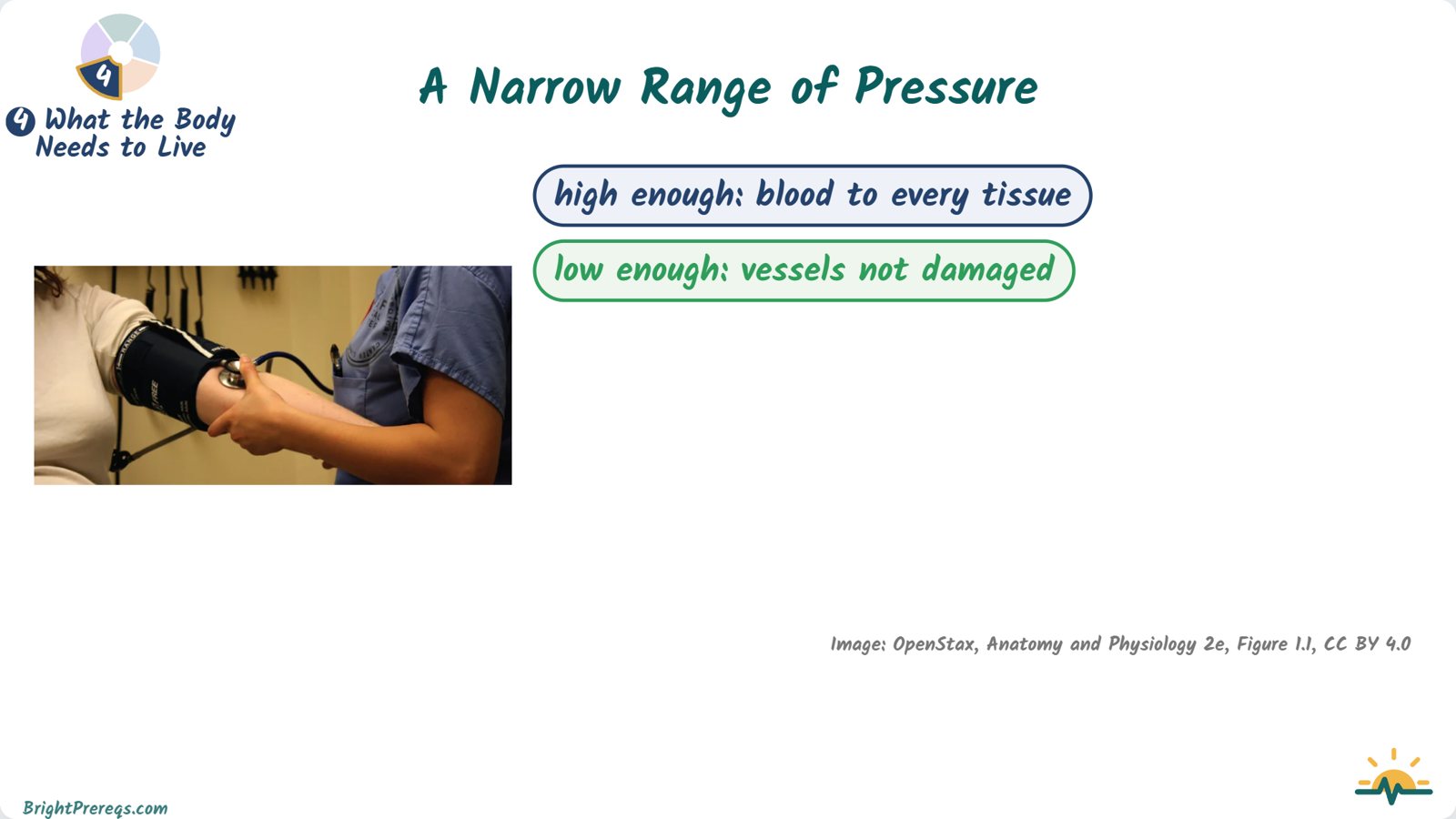
The fourth need is a narrow range of pressure. Air presses on the body all the time, and this air pressure keeps gases, such as nitrogen, dissolved in the body's fluids.
Breathing in oxygen and breathing out carbon dioxide also depend on the right air pressure. High in the mountains, the air pressure is lower, because there is less air above, pressing down on the body.
Altitude sickness happens partly because this lower pressure cuts the exchange of these gases. It causes shortness of breath, confusion, headache, lethargy and nausea. Mountain climbers carry oxygen to ease both the low oxygen and the low pressure.
Divers face the opposite problem. Coming up from a deep dive too fast drops the pressure quickly. When pressure drops, less gas can stay dissolved, so nitrogen comes out of the blood as bubbles, like opening a fizzy drink.
This is decompression sickness, called the bends for its joint pain. Untreated, very severe cases can cause death. It is treated with pure oxygen, then a pressure chamber called a hyperbaric chamber. The chamber raises the pressure on the body again, so it can then be let down much more slowly.
Blood pressure matters too. It must be high enough to push blood to every tissue, but low enough that the delicate blood vessels are not damaged.
Part 5: homeostasis, how the body keeps its inside steady.
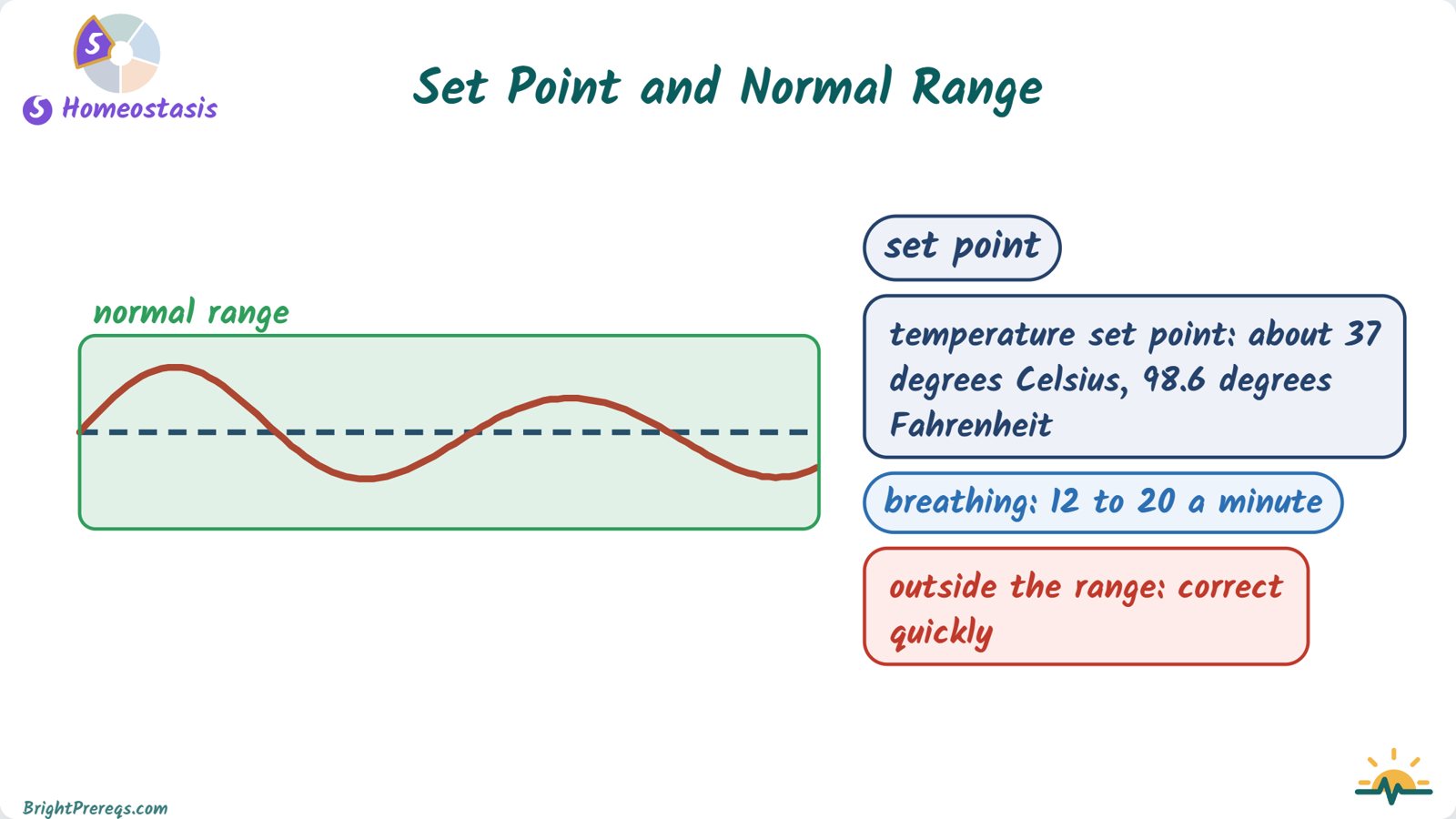
To keep homeostasis, the body checks its inside conditions all the time. Each one has a set point, the value its normal range moves around.
For body temperature, the set point is about 37 degrees Celsius, 98.6 degrees Fahrenheit. The normal range is the healthy band around it. In adults, a normal breathing rate is 12 to 20 breaths a minute.
A change outside the normal range must be corrected quickly. If not, it can cause disease, or even death.
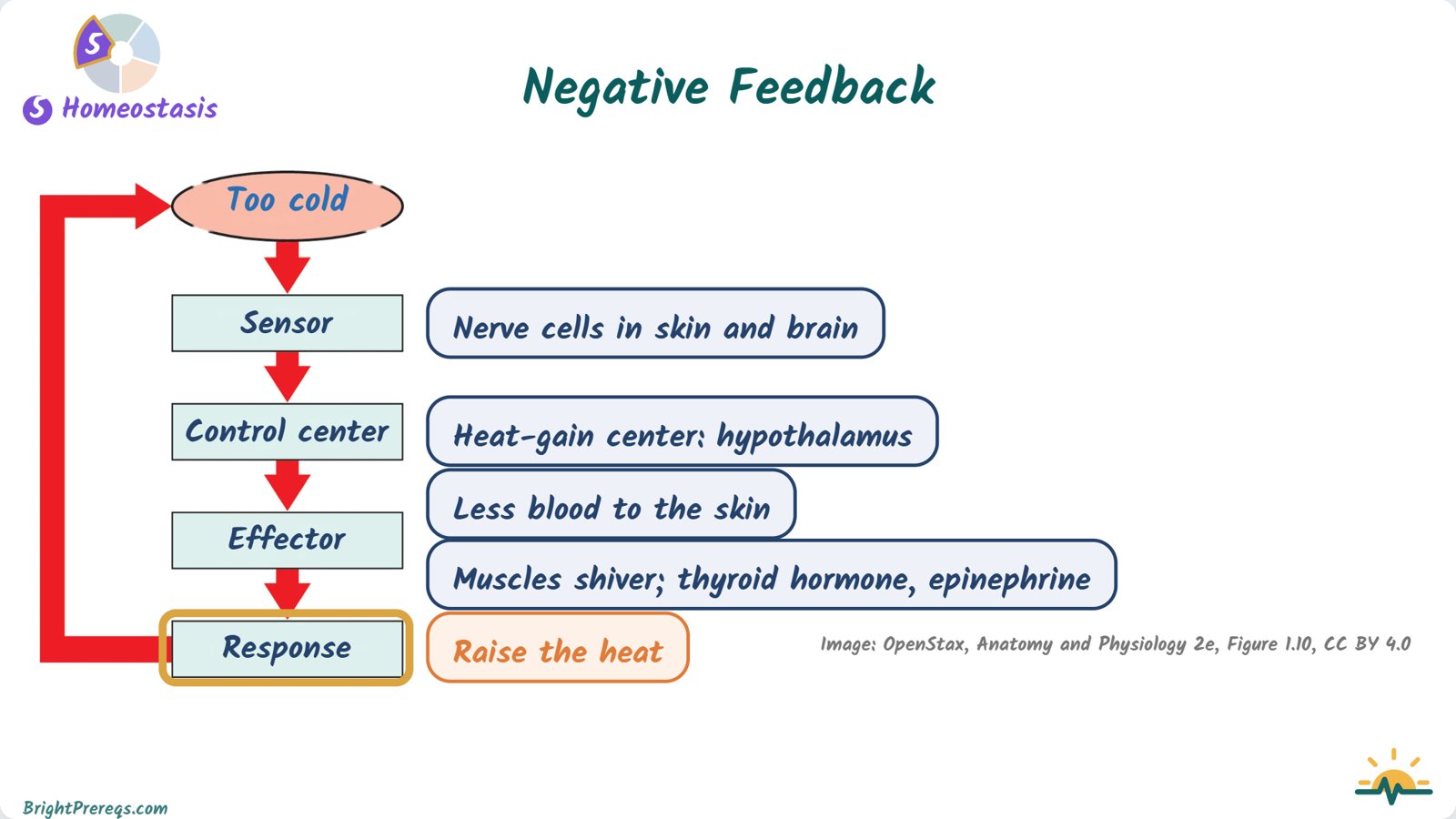
Most of the time, the body uses negative feedback. Negative feedback reverses a change, and brings the value back into the normal range.
It has three parts. A sensor, also called a receptor, checks a value. The control center compares it with the normal range. An effector makes the change that brings it back.
Blood sugar is one example. When there is extra glucose in the blood, beta cells in the pancreas sense it and release the hormone insulin.
Insulin signals muscle, fat and liver cells to take up the extra glucose. As blood glucose falls, insulin release stops, so the level does not keep dropping.
Body temperature works the same way. Nerve cells in the skin and brain sense the heat. The brain's temperature center, the hypothalamus, turns on heat loss.
Blood vessels in the skin widen, so more warm blood from the core reaches the skin. Sweat glands make more sweat, and breathing gets deeper, so more heat leaves from the lungs. Heat leaves, and the temperature comes back down.
In the cold, the heat-gain center does the reverse. Less blood flows to the skin, and blood is kept in deep veins, which traps heat close to the core.
If heat loss is severe, the muscles shiver. The thyroid gland releases thyroid hormone, and the adrenal glands release epinephrine, also called adrenaline. Both raise the heat the body makes. Sensor, control center, effector: each negative feedback loop brings the value back into the normal range.
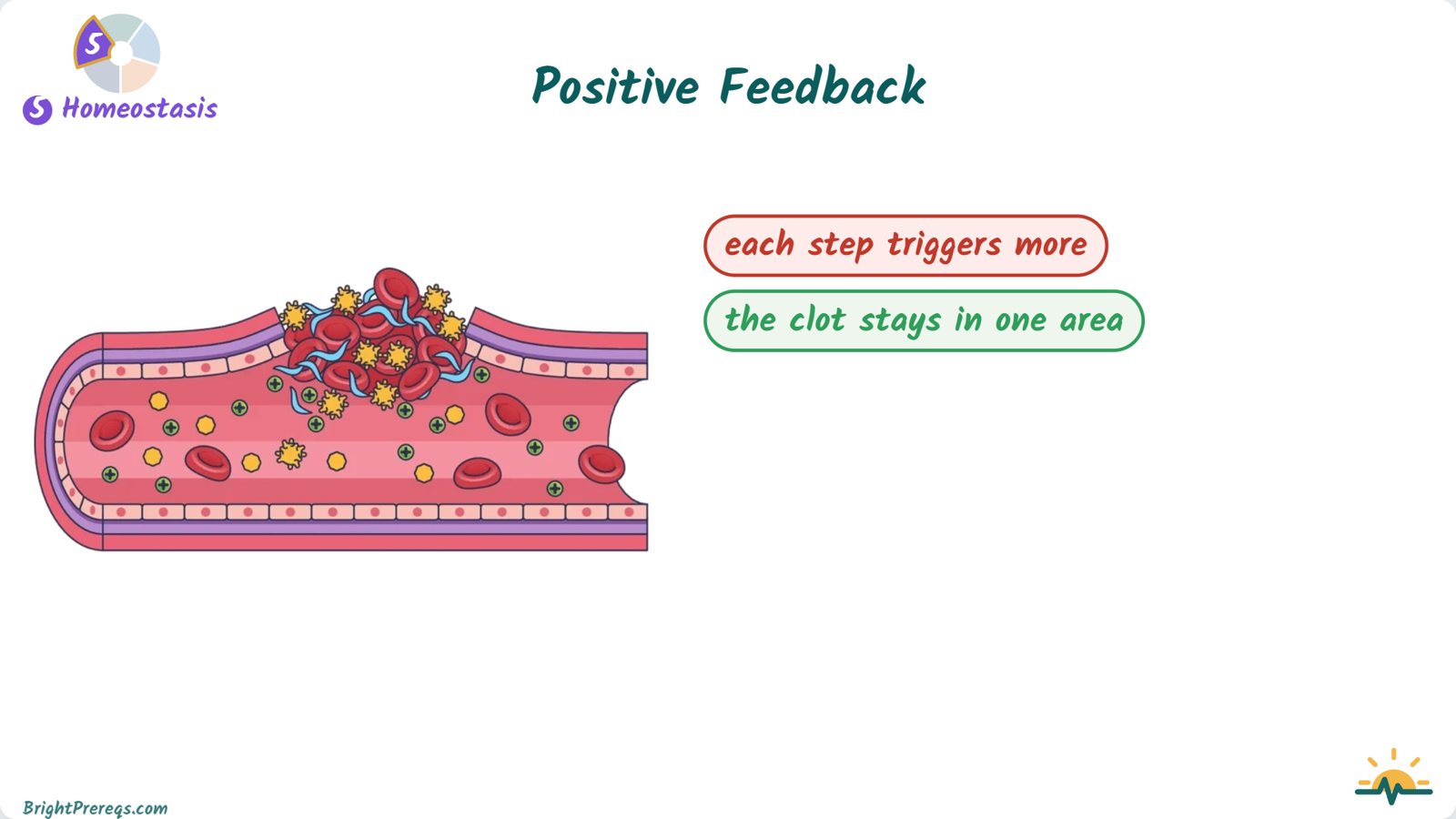
Positive feedback is the opposite. It makes a change stronger, moving farther from normal. In the body, it is normal only when there is a clear end point.
Childbirth is one example. Once it starts, it must finish quickly, or the lives of the person giving birth and the baby are at risk. Contractions push the baby toward the cervix, the lowest part of the uterus. Stretch-sensing nerves there signal the brain.
The pituitary gland releases the hormone oxytocin, which makes the uterus contract harder. That stretches the cervix more. The loop repeats, stronger each time, and stops only when the baby is born.
Blood loss is the second example. A damaged blood vessel wall releases clotting substances. Each step of clotting triggers more, sealing the wound quickly, and the clot stays in that one area, because the supply of clotting proteins is tightly controlled. Childbirth stops at the birth, and clotting at the sealed wound: positive feedback runs to an end point.
To recap. How is the body built? In six levels, each built from the one below: chemical, cell, tissue, organ, organ system and organism. The organism has eleven organ systems.
What does the body do to stay alive? Six functions of life: organization, metabolism, responsiveness, movement, development and reproduction.
What does it need? It needs oxygen, nutrients, and a narrow range of temperature and pressure. Without oxygen, minutes. Without water, days. Without the energy-giving nutrients, weeks.
How does it keep itself steady? With feedback. Negative feedback reverses a change, through a sensor, a control center and an effector. Positive feedback makes a change stronger until an end point.
The next video is Anatomical Terms: Positions, Directions, Planes, Body Cavities and Medical Imaging.
The chapters this video teaches from, in OpenStax Anatomy and Physiology 2e and OpenRN General Anatomy & Physiology, free to read on BrightPrereqs.com.
Bright Beats Anatomy and Physiology, in textbook order.
Textbook pages cited: Anatomy and Physiology 2e, J. Gordon Betts et al., OpenStax, Rice University, CC BY-NC-SA 4.0, access for free at openstax.org; General Anatomy & Physiology, edited by Julia Brown, WisTech Open, CC BY-NC-SA 4.0.