Bright Beats Anatomy and Physiology · Study Sheet
Body Chemistry: Atoms, Bonds, Reactions, Water, Acids, Bases and pH
Body Basics · Video code CH1
 Scan to watch
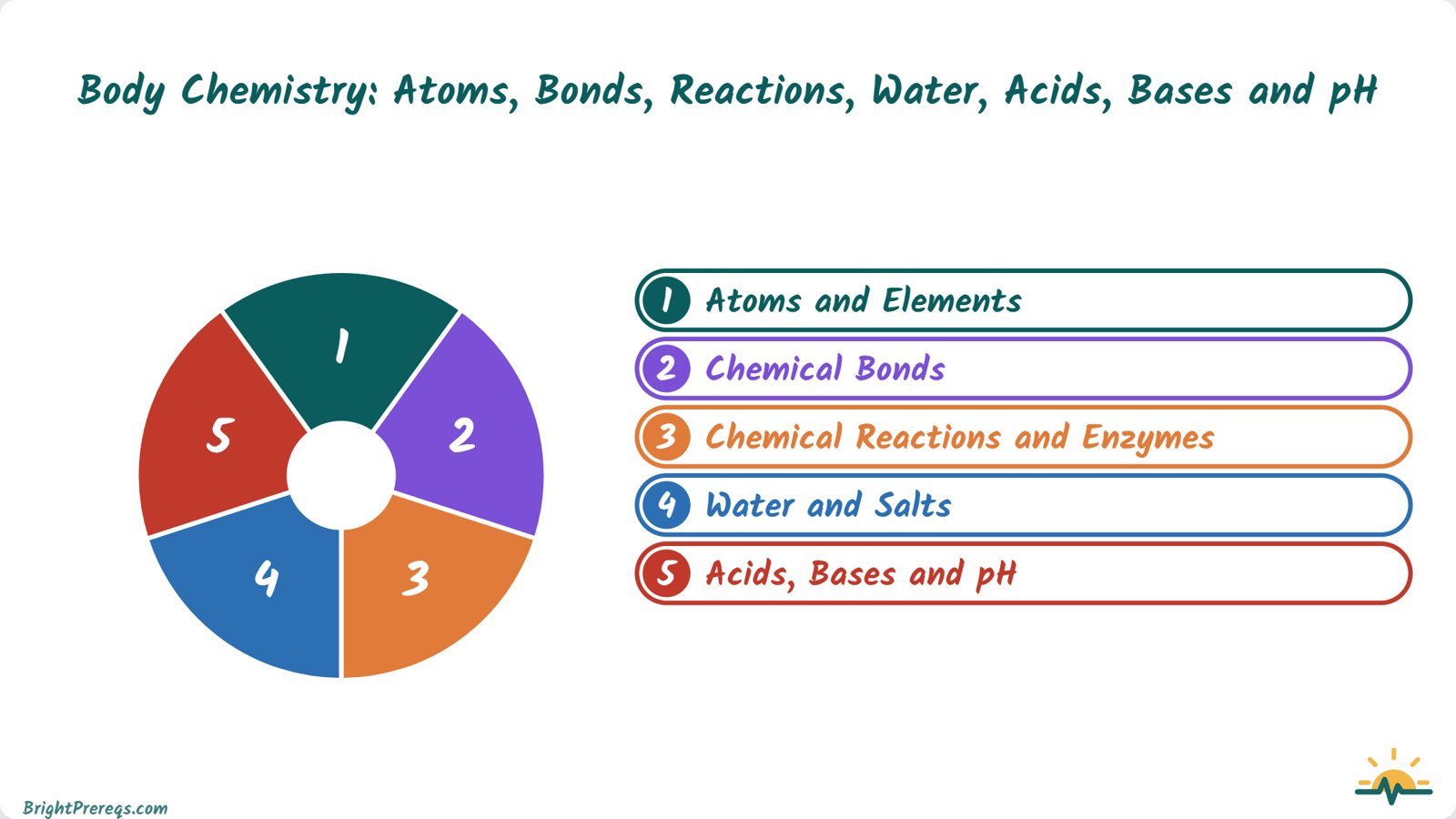
Anatomy and Physiology, Body Basics. Body chemistry: atoms, bonds, reactions, water, acids, bases and pH.
What is the body made of, and why must the blood stay in such a narrow pH range?
Five parts follow: atoms and elements; chemical bonds; chemical reactions and enzymes; water and salts; and acids, bases and pH.
Part 1: atoms and elements, what the body is made of.
Everything in the world, and everything in the body, is matter. Matter is anything that takes up space and has mass.
All matter is made of elements. An element is a pure substance that cannot be made or broken down by ordinary chemical means. Nature has 92 of them.
The body cannot make elements. Every element in the body comes from food and from the air.
Calcium is one example. The calcium in cheese is the same calcium that builds the bones.
The four most common elements in the body, most common first, are oxygen, carbon, hydrogen and nitrogen.
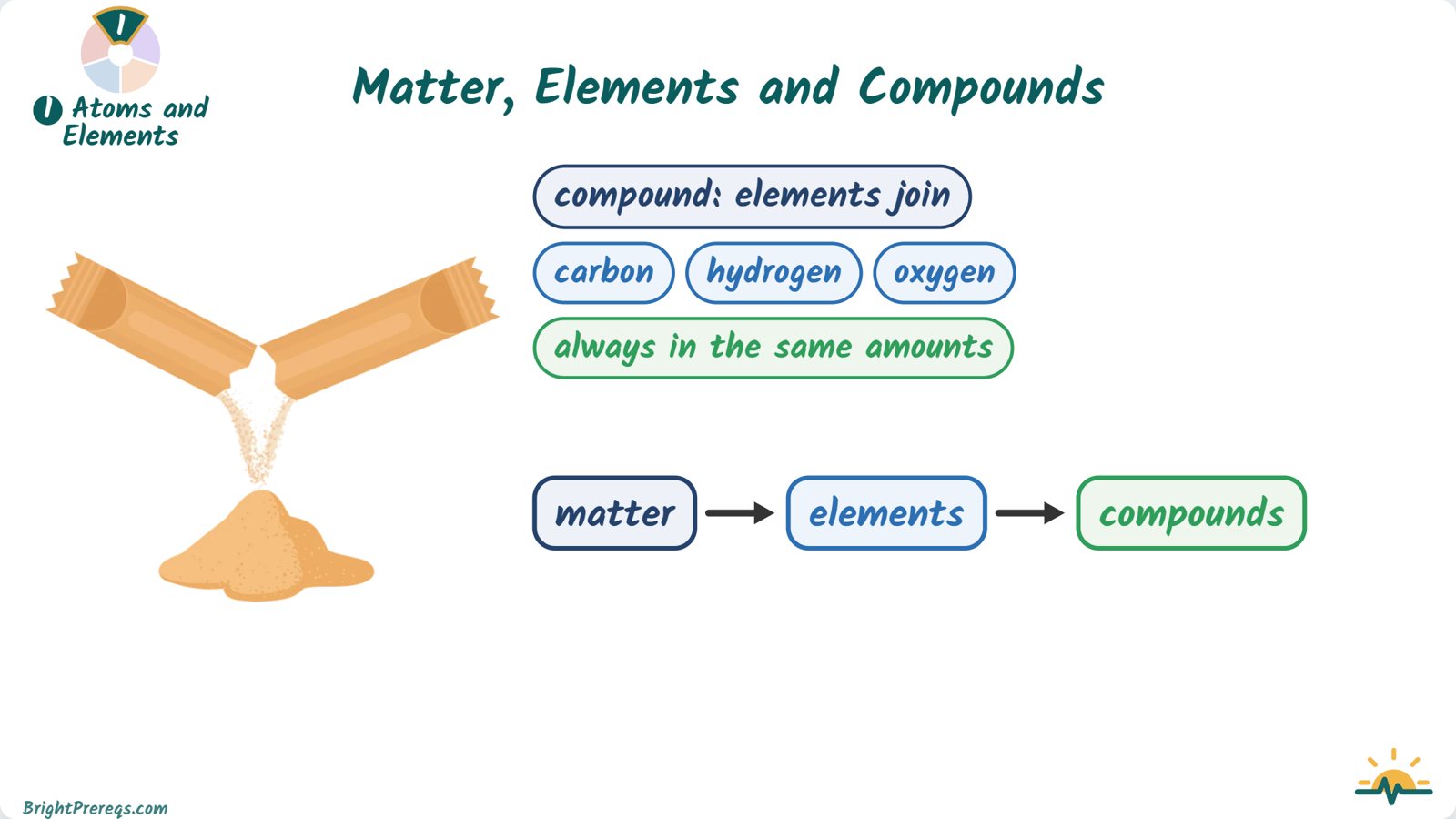
Elements join to make compounds. Glucose, a body fuel, is a compound of carbon, hydrogen and oxygen, always in the same amounts. So all matter is elements, alone or joined into compounds.
An atom is the smallest amount of an element that still acts like that element. Atoms are tiny: a printed period is millions of atoms wide.
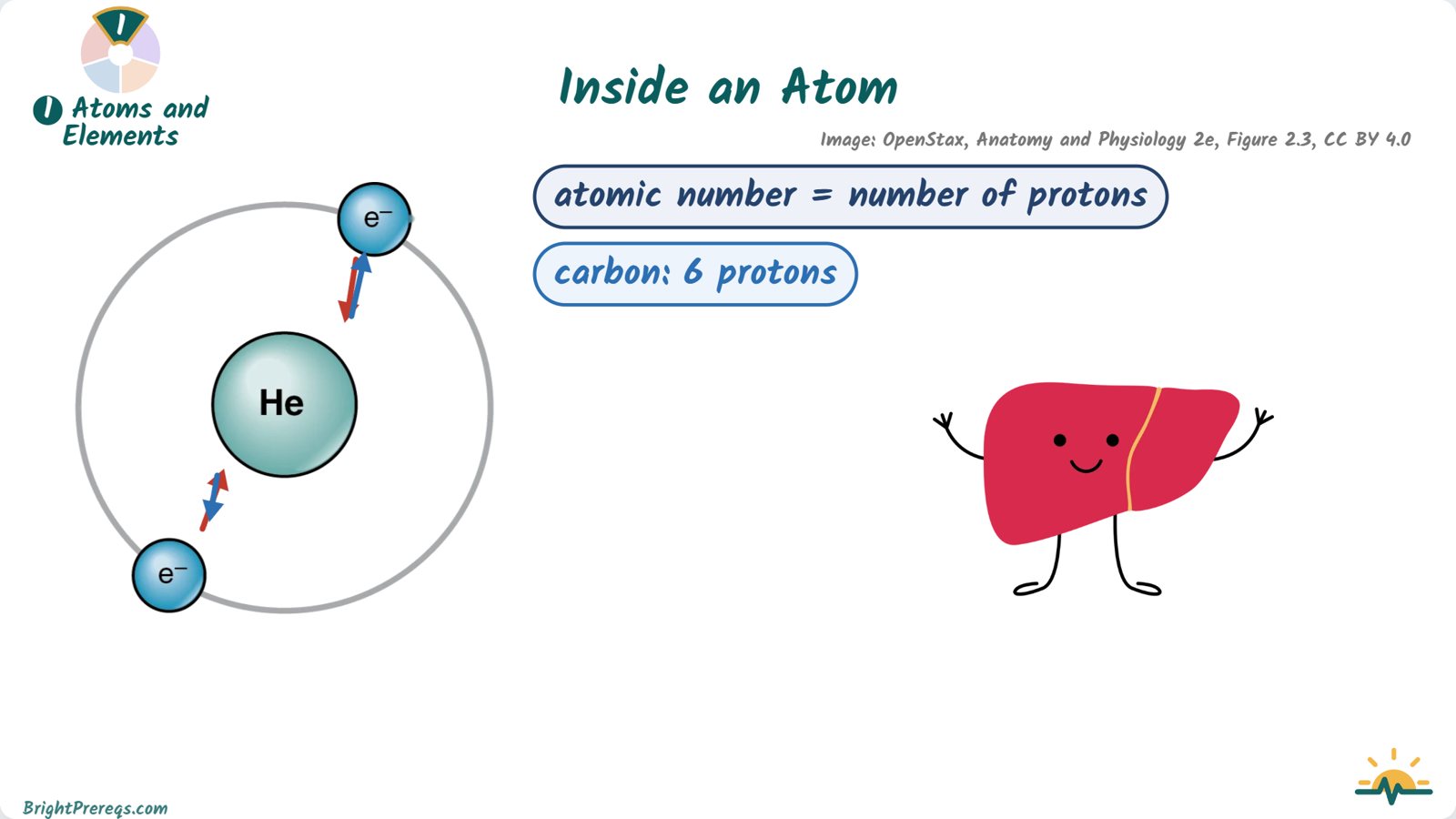
An atom has three main parts. In its center, the nucleus, are protons, with a positive charge, and neutrons, with no charge.
Electrons, with a negative charge, move around the nucleus. An electron has only about one two-thousandth the mass of a proton.
Opposite charges attract, so the positive protons hold the negative electrons close. In a neutral atom, the numbers of protons and electrons are equal.
The number of protons is the atomic number, and it names the element. Every carbon atom has six protons, whether in the liver or in a lump of coal. Nucleus in the center, electrons around it, and the protons name the element.
The protons name the element, but the number of neutrons can differ. These different forms of one element are called isotopes.
An isotope with extra neutrons is heavy, and heavy isotopes tend to be unstable. An unstable isotope is radioactive: its nucleus breaks down and gives off particles and energy.
Too much radiation can damage cells and even cause cancer. But in controlled amounts, some radioactive isotopes are useful in medicine.
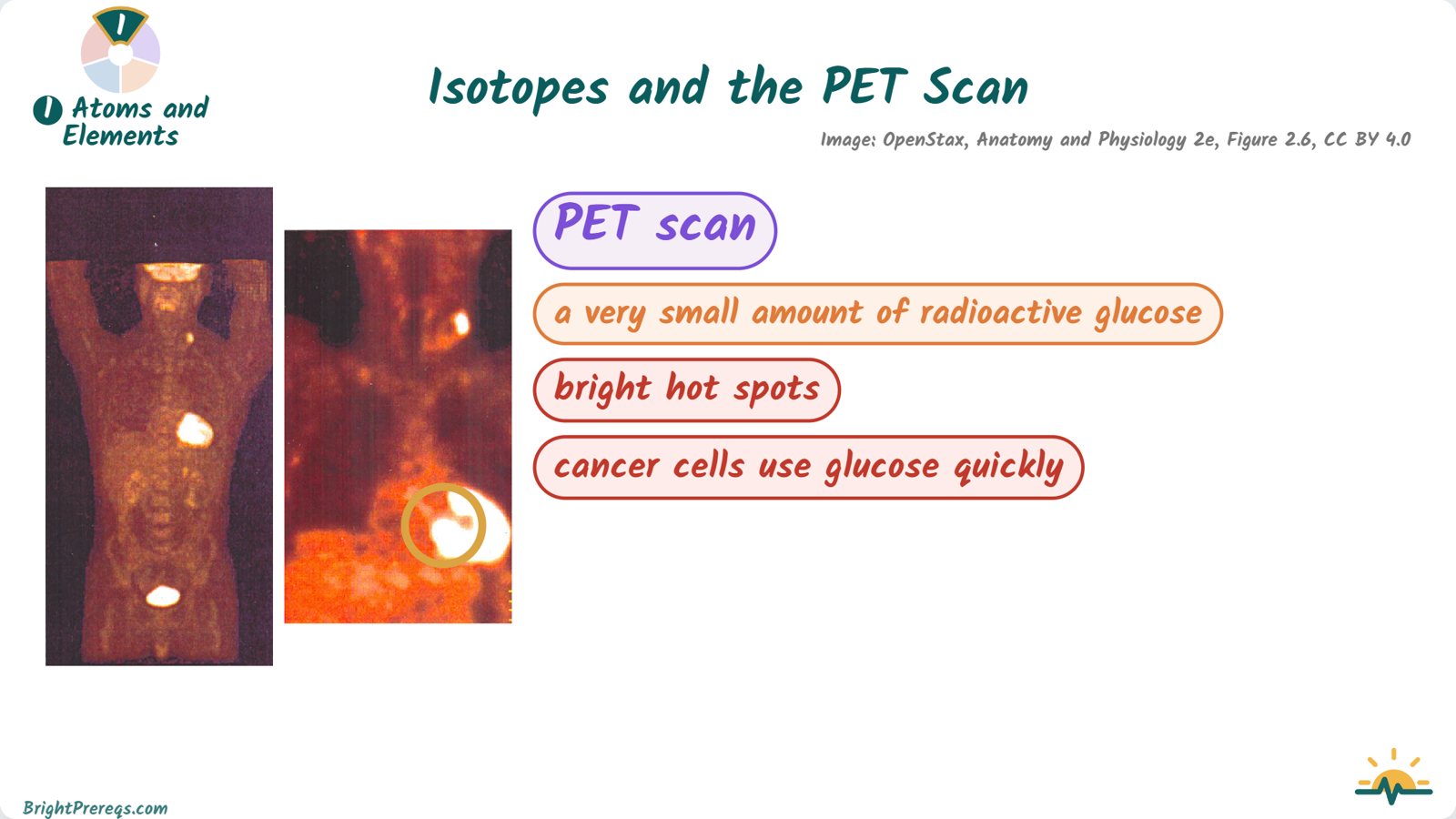
One medical use is the positron emission tomography scan, or PET scan. A very small amount of radioactive glucose is injected, and the tissues using the most glucose show up as bright hot spots.
Cancer cells use glucose quickly, so a PET scan can show some cancers. An unstable isotope, in a small, controlled amount, helps find them.
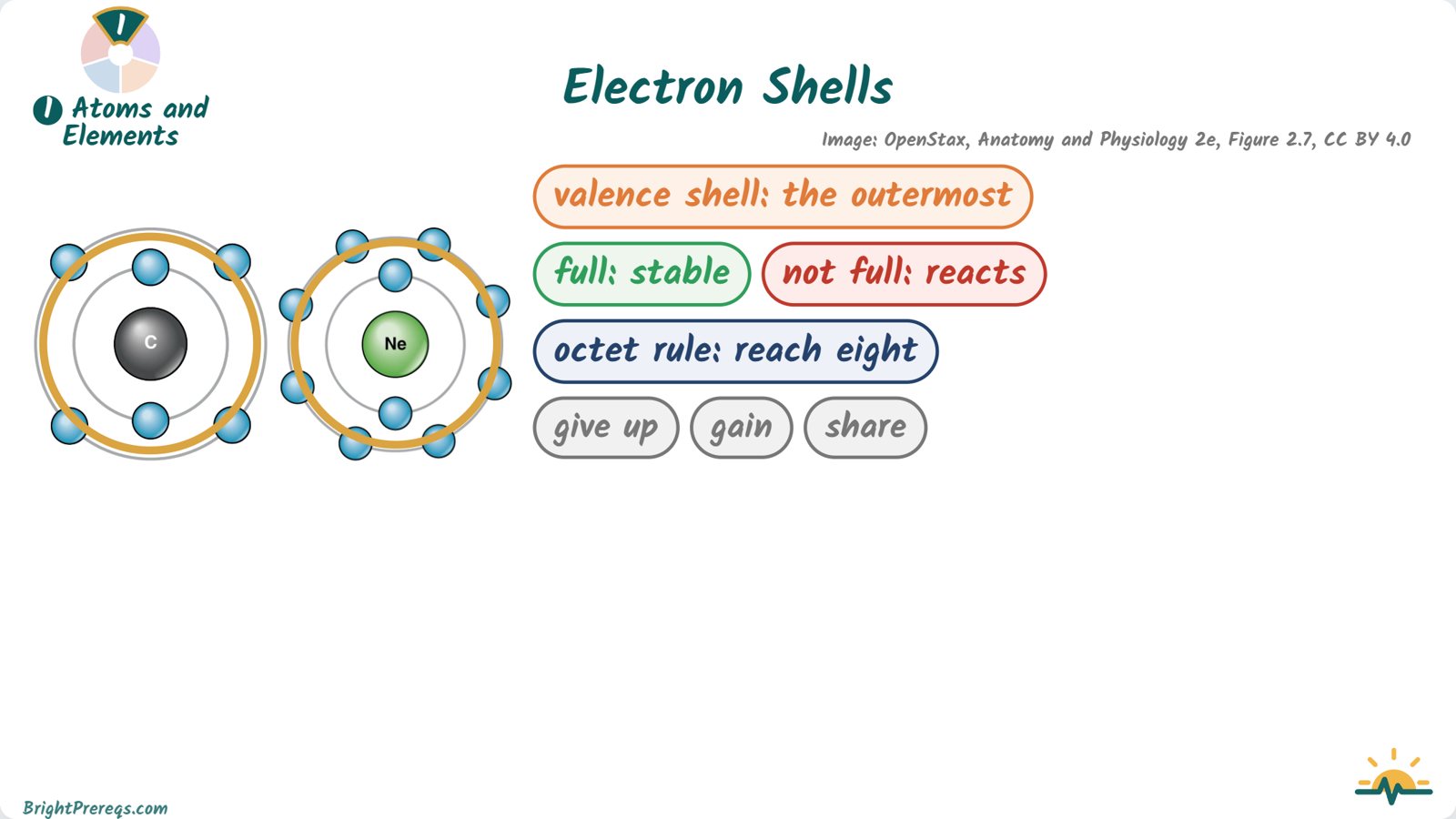
Electrons stay in layers around the nucleus, called electron shells. The first shell holds only two electrons. The second holds up to eight.
The outermost shell is the valence shell. When it is full, the atom is stable: other atoms' charges are unlikely to pull its electrons away. When it is not full, the atom reacts with other atoms to fill it.
Most atoms are most stable with eight electrons in the valence shell. This is the octet rule: atoms give up, gain or share electrons to reach eight.
Part 2: chemical bonds, how atoms join.
Atoms join by forming chemical bonds. A bond is an electrical pull that holds atoms near each other. Two or more bonded atoms make a molecule.
Three kinds of bonds matter most in the body: ionic bonds, covalent bonds and hydrogen bonds.
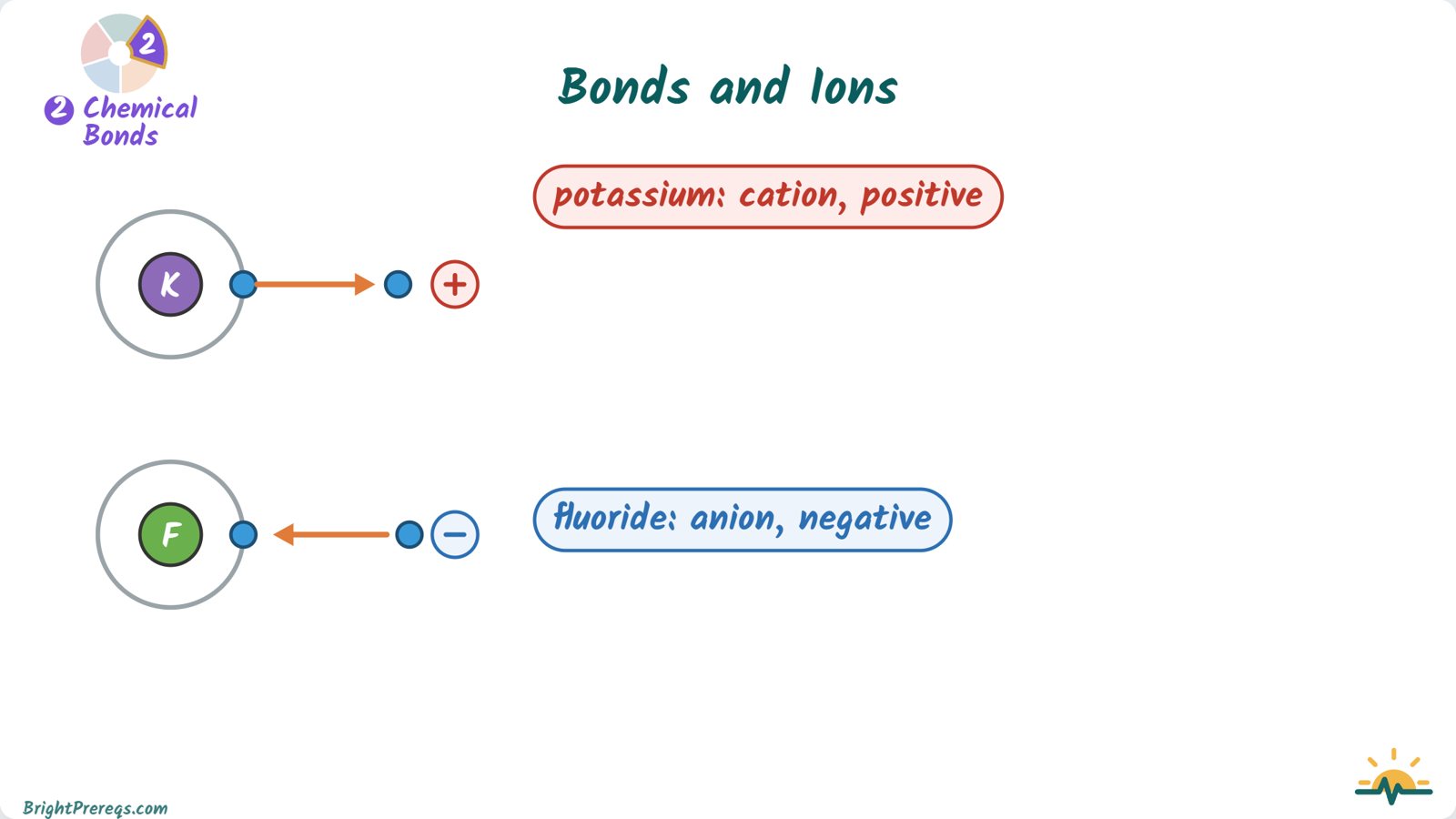
When an atom gives up or gains electrons, it takes on a charge. An atom with a charge is called an ion.
Potassium gives up its one outer electron and becomes a positive ion, called a cation. Fluorine, part of bones and teeth, gains one electron and becomes the negative ion fluoride, called an anion.
Opposite charges attract. A positive ion and a negative ion held together make an ionic bond. Table salt is the classic example: sodium gives an electron to chlorine, and the two ions hold tight.
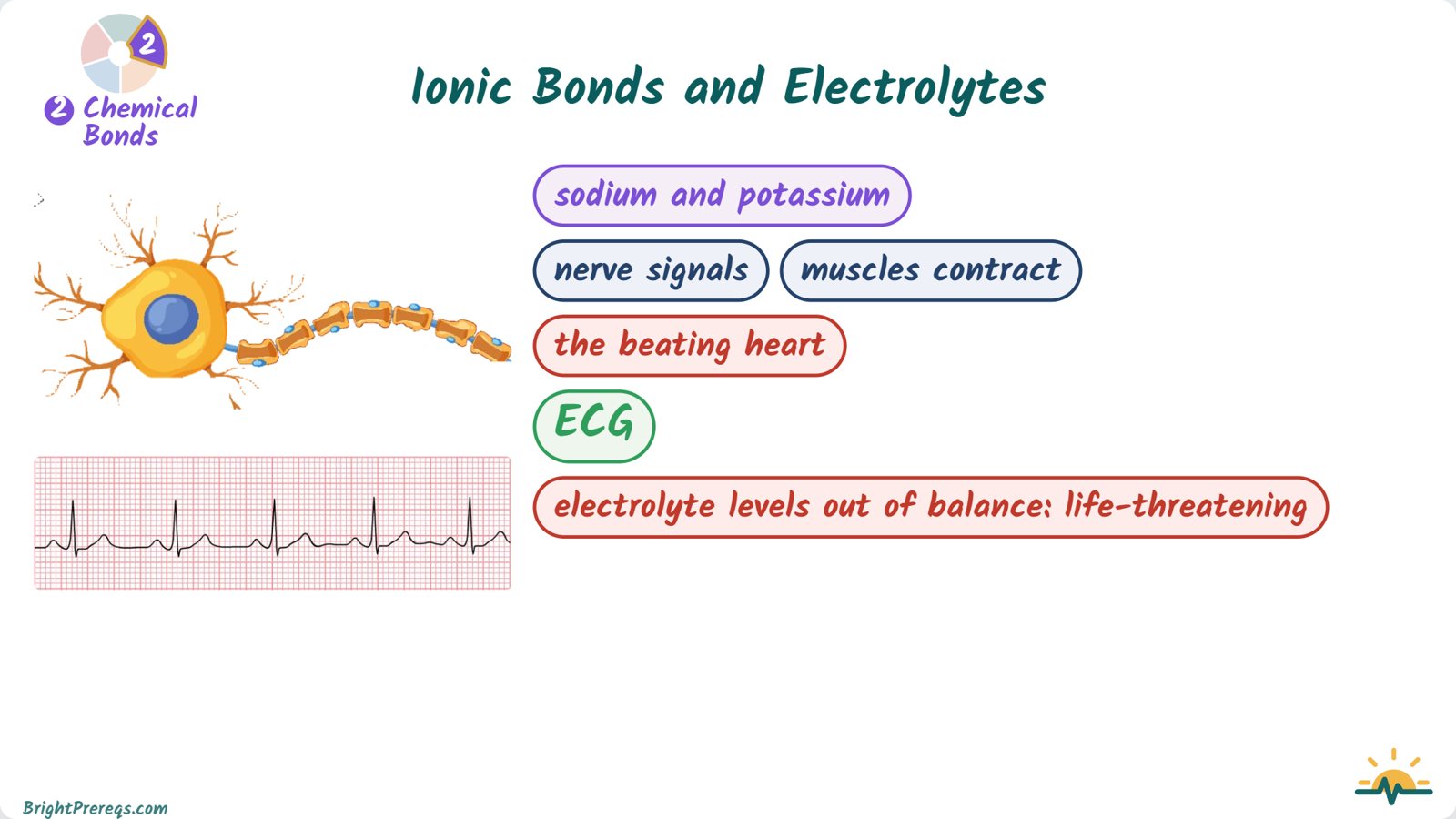
In body fluids, most atoms exist as ions. Their charges carry electricity, so ions are also called electrolytes.
Electrolytes such as sodium and potassium carry nerve signals and make muscles contract, including the beating heart. Their electricity makes the waves on an electrocardiogram, or ECG.
When electrolyte levels fall out of balance, it can be life-threatening.
In a covalent bond, two atoms share electrons instead of giving them up or gaining them, like next-door neighbors whose kids play first at one home, then the other. Because the two atoms share pairs of electrons so closely, covalent bonds are stronger than ionic bonds.
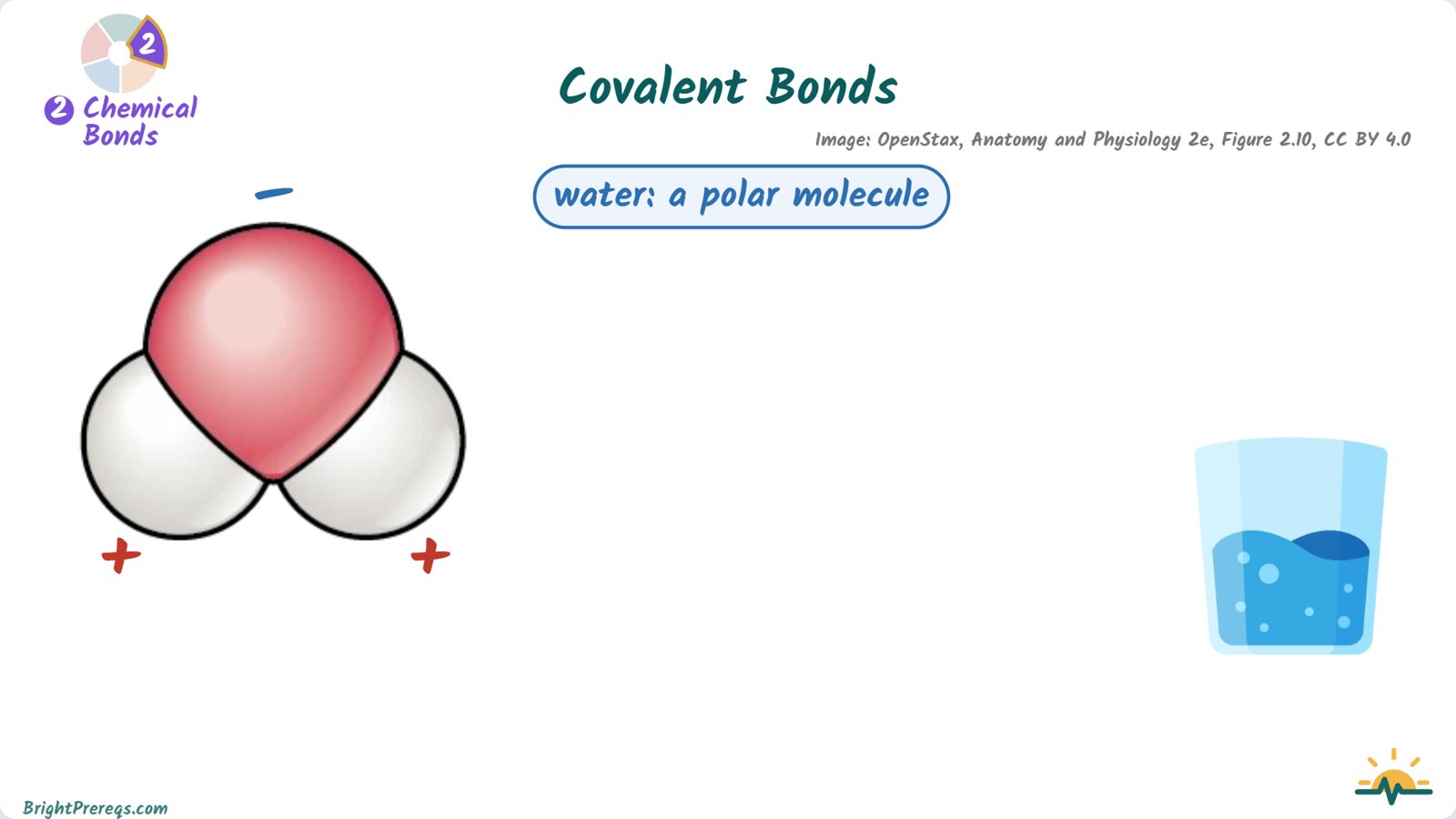
When atoms share evenly, the molecule is nonpolar. When they share unevenly, it is polar, with one end slightly positive and the other slightly negative.
Water is the best-known polar molecule. Oxygen pulls the shared electrons closer, so the oxygen end is slightly negative, and the hydrogen ends are slightly positive.
A hydrogen bond is a weak pull between a slightly positive hydrogen and a slightly negative atom in another molecule. Hydrogen bonds link water molecules, which is why two raindrops merge into one.
Because water is polar, it pulls salt apart, so salt dissolves. But water pushes away nonpolar oils and fats, so oil forms beads in water.
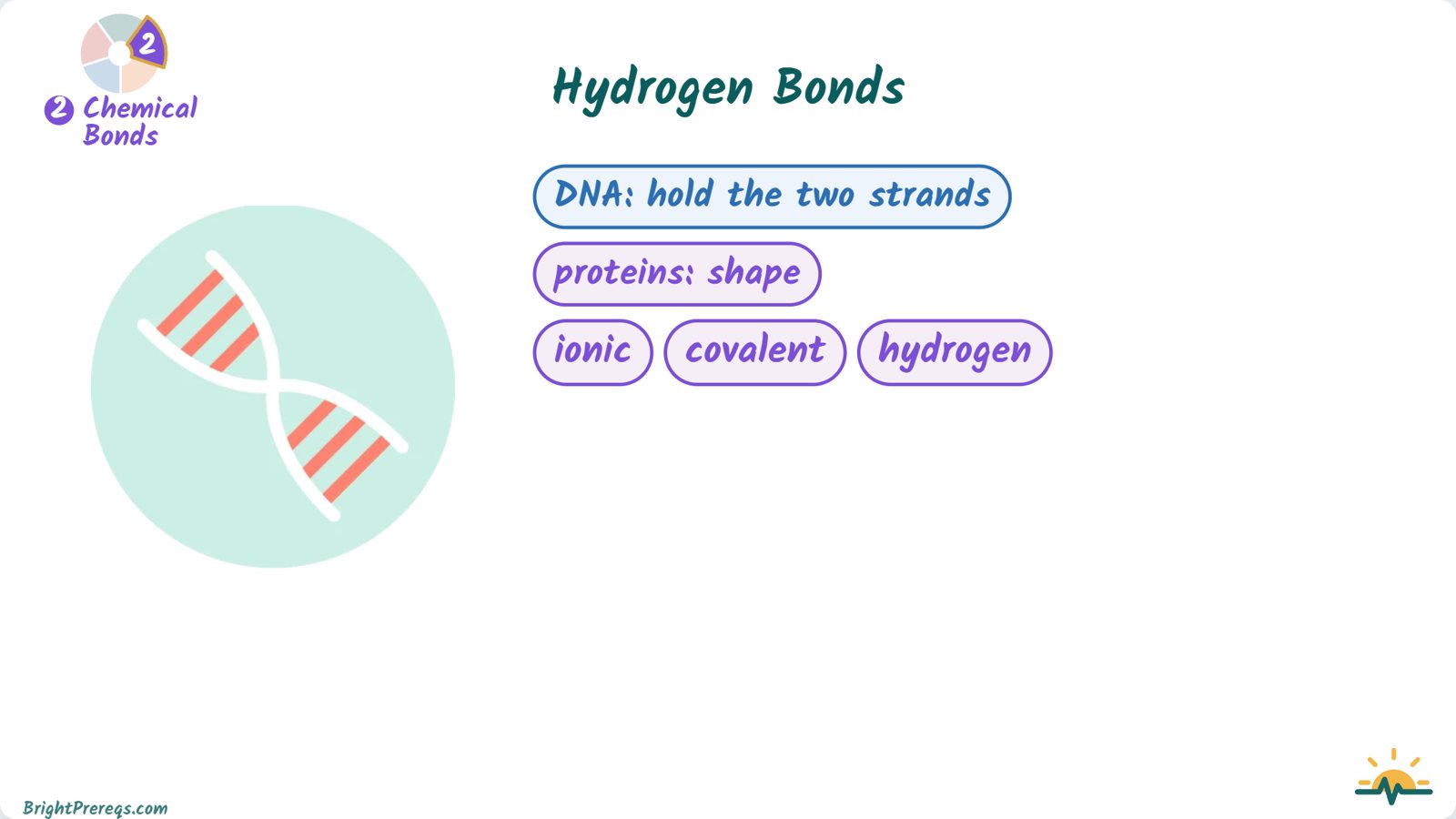
Hydrogen bonds also hold the two strands of DNA together, and help give proteins their shape. Ionic, covalent, hydrogen: the three bonds that matter most in the body.
Part 3: chemical reactions and enzymes, how old bonds break and new ones form.
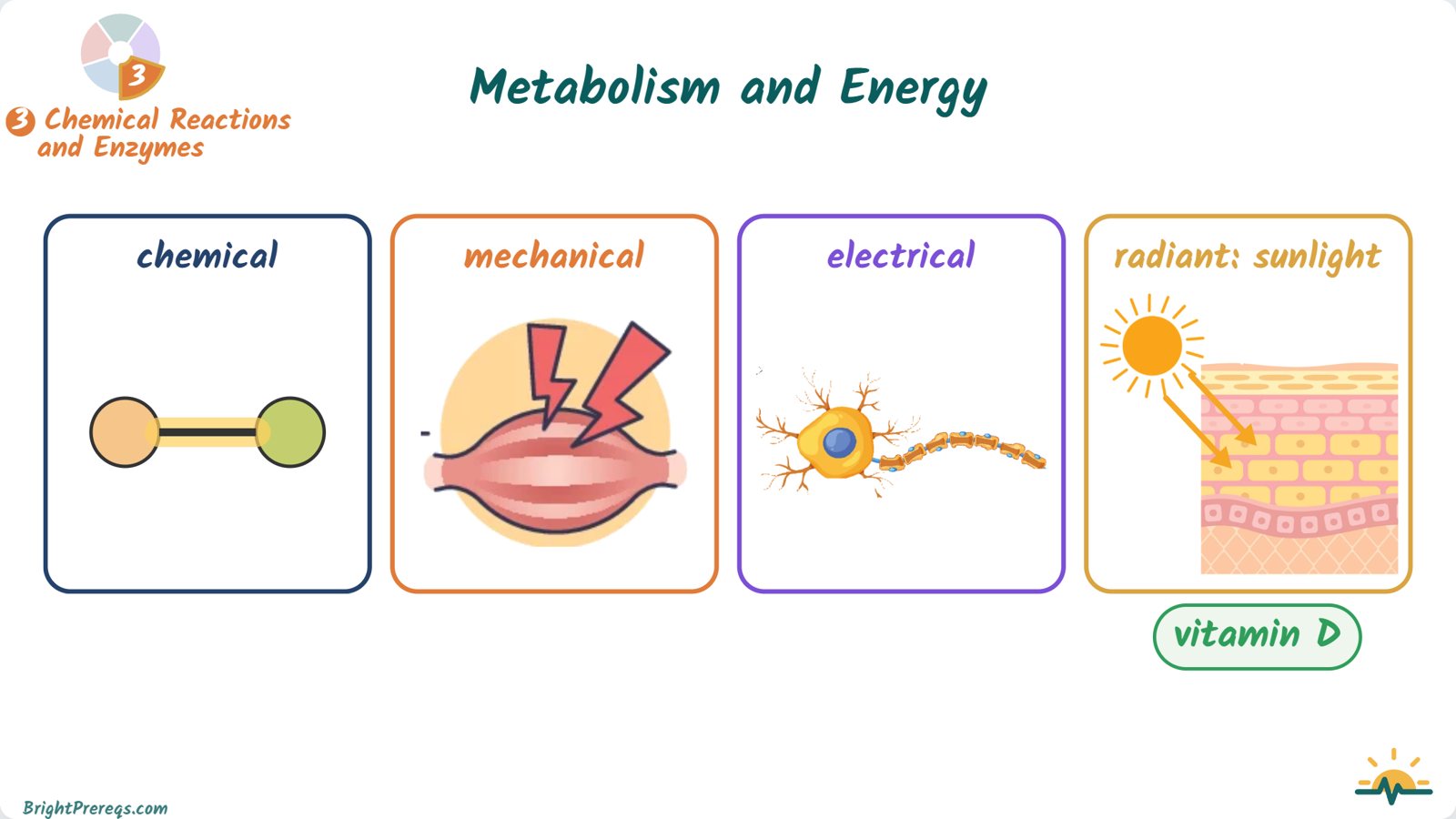
Metabolism is the sum of all the chemical reactions in the body. Building larger molecules is called anabolic. Breaking them down is called catabolic. Both involve energy, not only matter.
Kinetic energy is the energy of motion. Potential energy is stored energy. In the body, energy is stored in the bonds between atoms.
Making a bond stores chemical energy, and breaking a bond releases it. So building up stores energy, and breaking down releases it. Energy is never created or destroyed; it only changes form.
Besides chemical energy, three other forms matter in the body. Muscles use mechanical energy to move things. Electrolytes give electrical energy to nerve and muscle signals. And the skin uses radiant energy, the ultraviolet energy of sunlight, to make vitamin D.
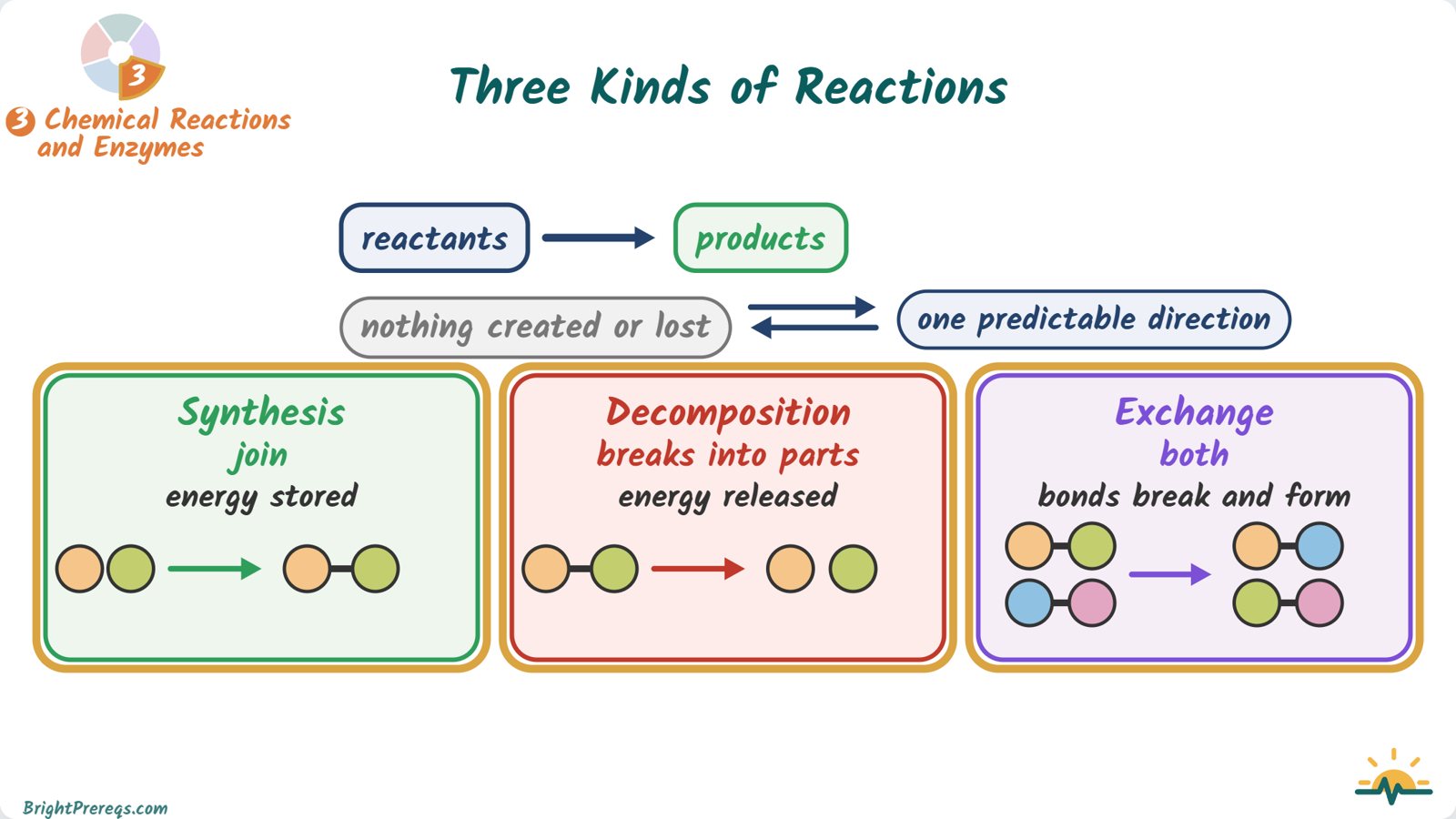
Every chemical reaction starts with reactants and ends with products. Nothing is created or lost: the same atoms are in the products as in the reactants.
A synthesis reaction builds up: parts join to make something larger, and energy is stored in the new bonds. A decomposition reaction breaks down: something larger breaks into its parts, and the stored energy is released.
An exchange reaction does both: some bonds break and new ones form. Many reactions can run both ways, but in the body many run in one predictable direction. Join, break apart, or both: the three kinds of reactions.
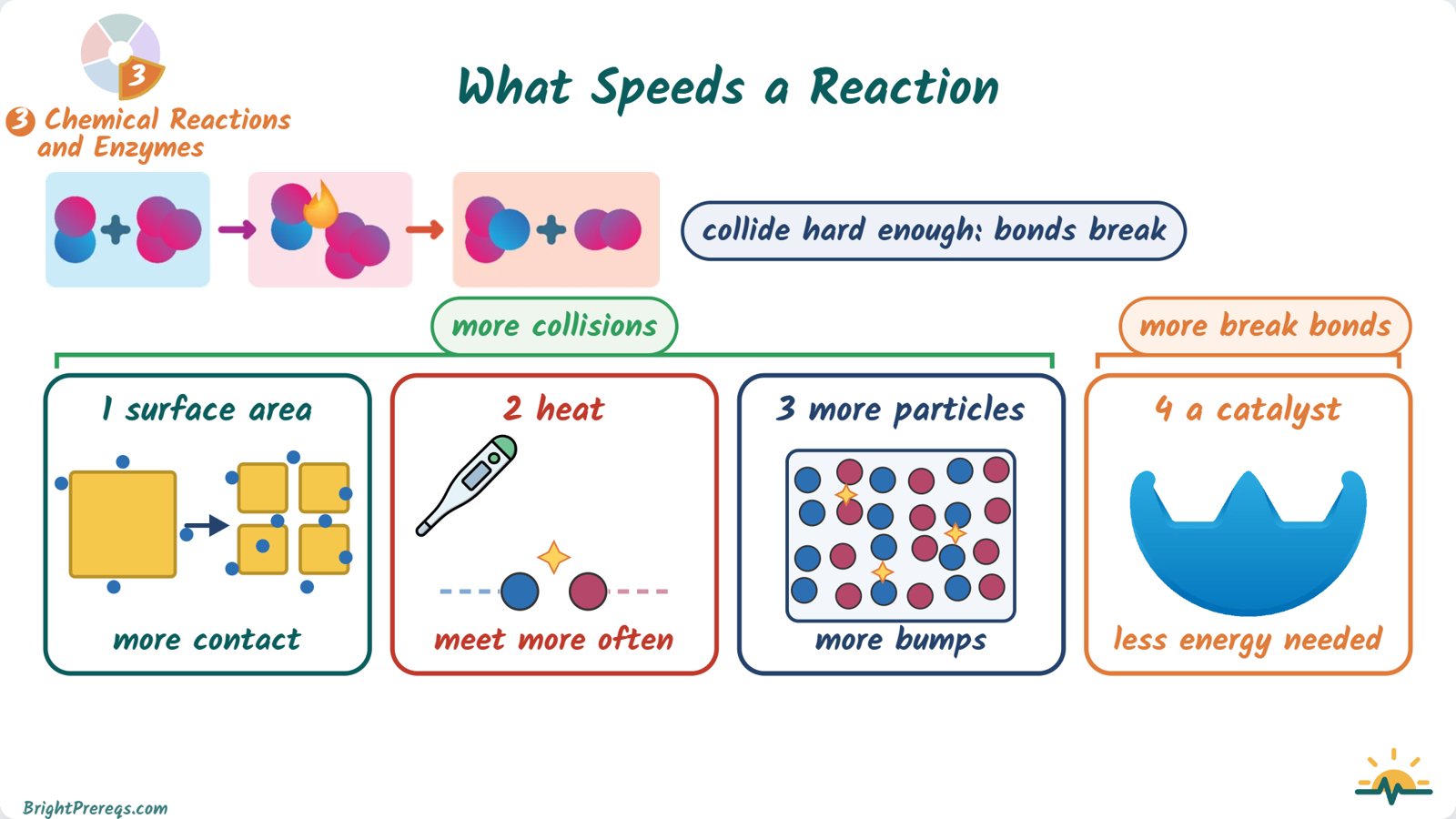
A reaction needs particles to collide hard enough to break their old bonds. Anything that brings more of those collisions speeds a reaction up. First, more surface area. Atoms need easy access to one another, so the more surface there is, the more readily they react. A cube of cheese is chewed into small pieces, so digestive chemicals can get at more of it.
Second, heat. The higher the temperature, the faster the particles move, so they meet more often and react. Third, more particles in a space. On a crowded dance floor, people bump into one another more often. Particles packed into a space do the same.
But heat has a limit. Very high heat, such as a very high fever, can harm body cells and be life-threatening. And typical body temperature is not hot enough to drive the reactions that keep a person alive.
That is where the fourth comes in: a catalyst. A catalyst speeds up a reaction without being changed itself. It lowers the energy a reaction needs, so less energy is enough to break the bonds. Surface area, heat and more particles bring more collisions. A catalyst makes more of them break bonds.
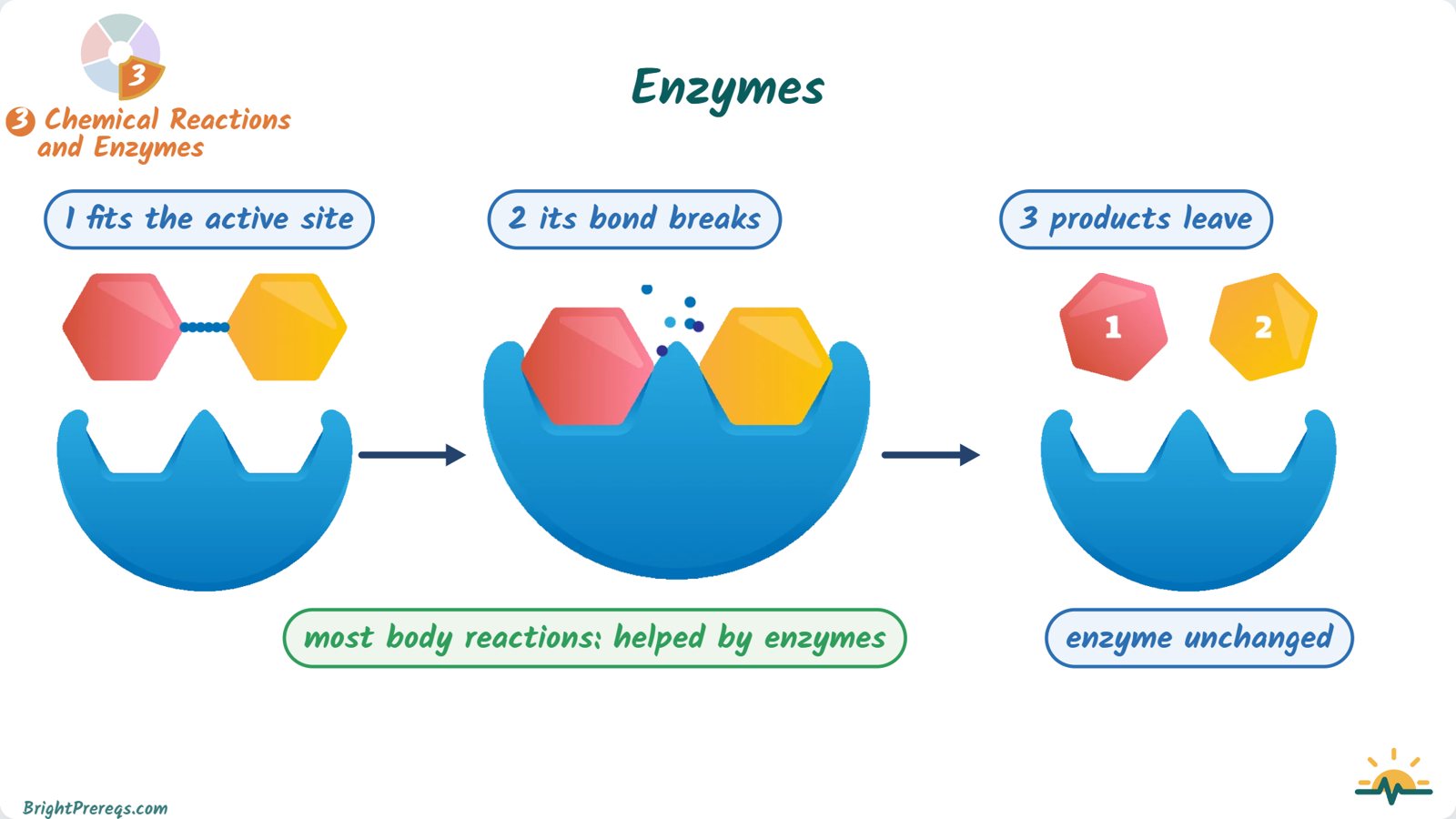
The body's most important catalysts are enzymes. An enzyme is made of protein, or of a nucleic acid called ribonucleic acid, or RNA. Like all catalysts, enzymes work by lowering the energy a reaction needs.
To begin, a reaction needs enough energy to break the bonds in the reactants. Picture this threshold as a hill the particles must get over: the activation energy. Without an enzyme, the hill is high, and a much larger push of energy is needed. With an enzyme, the hill is lower, so less energy is needed, and more particles roll over it. The reaction runs faster.
Here is how. The reactant, called the substrate, fits the enzyme's active site like a puzzle piece. Held there, its bond breaks. The products leave, and the enzyme comes out unchanged, free to work again. Most chemical reactions in the body, such as breaking down food, are helped by enzymes.
Part 4: water and salts. The body's reactions happen in water, and salts dissolve in it.
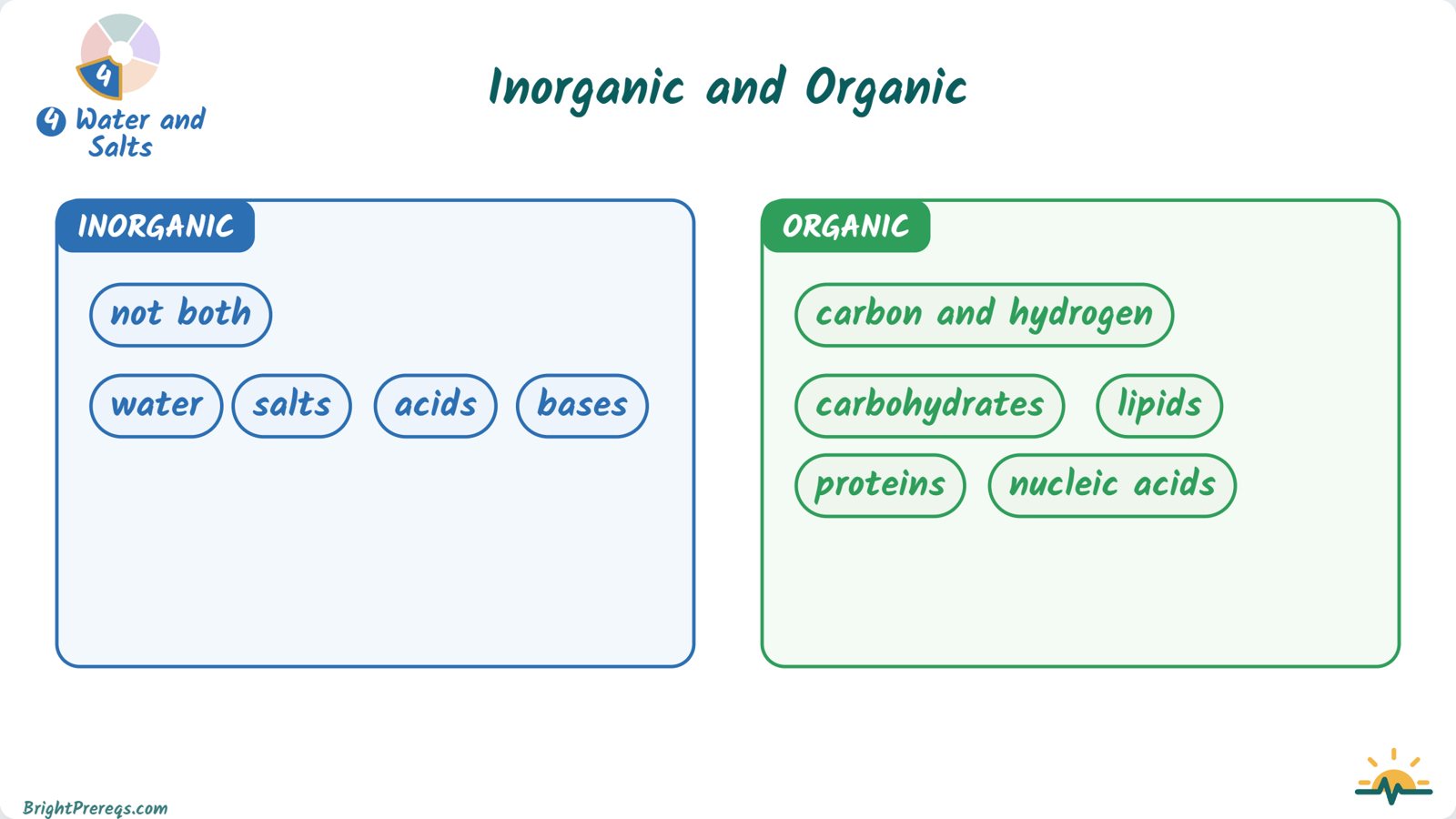
Body compounds come in two groups. An inorganic compound does not contain both carbon and hydrogen. An organic compound contains both.
Water, salts, acids and bases are inorganic. Carbohydrates, lipids, proteins and nucleic acids are organic.
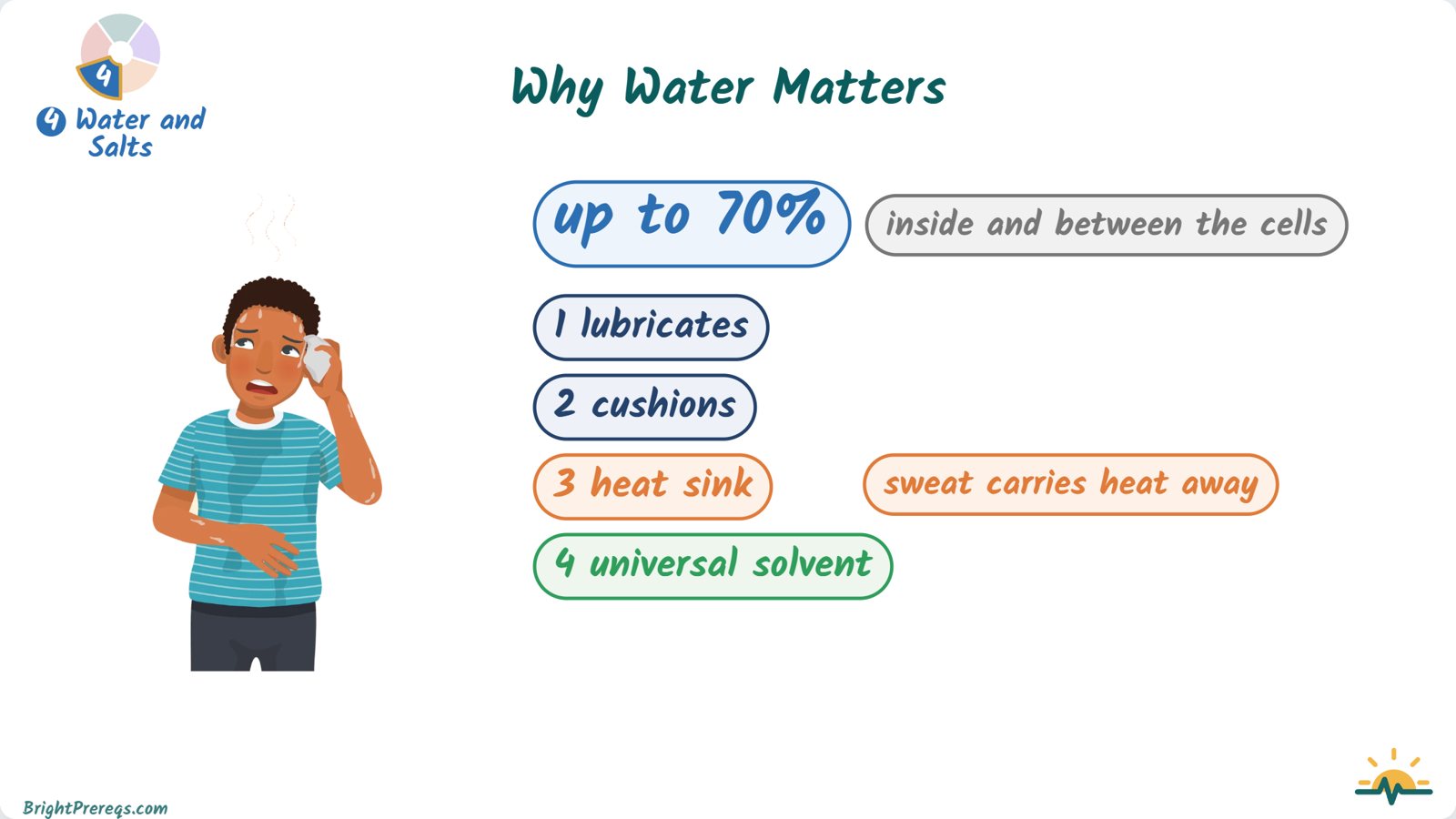
Up to 70 percent of an adult's body weight is water, inside the cells and between them, and that water does four jobs.
First, water lubricates, in the fluid of the joints and the fluid that helps the lungs expand and recoil. Second, it cushions the brain inside the skull, the nerve tissue of the eyes, and a growing fetus.
Third, water is a heat sink: it soaks up the heat made by the body's chemical reactions without getting much hotter. On a hot day, warm blood flows to the vessels under the skin, and sweat evaporates from the skin and carries heat away.
Fourth, water is the universal solvent. Almost all of the body's chemical reactions happen in substances dissolved in water. So water lubricates, cushions, soaks up heat and dissolves: four jobs.
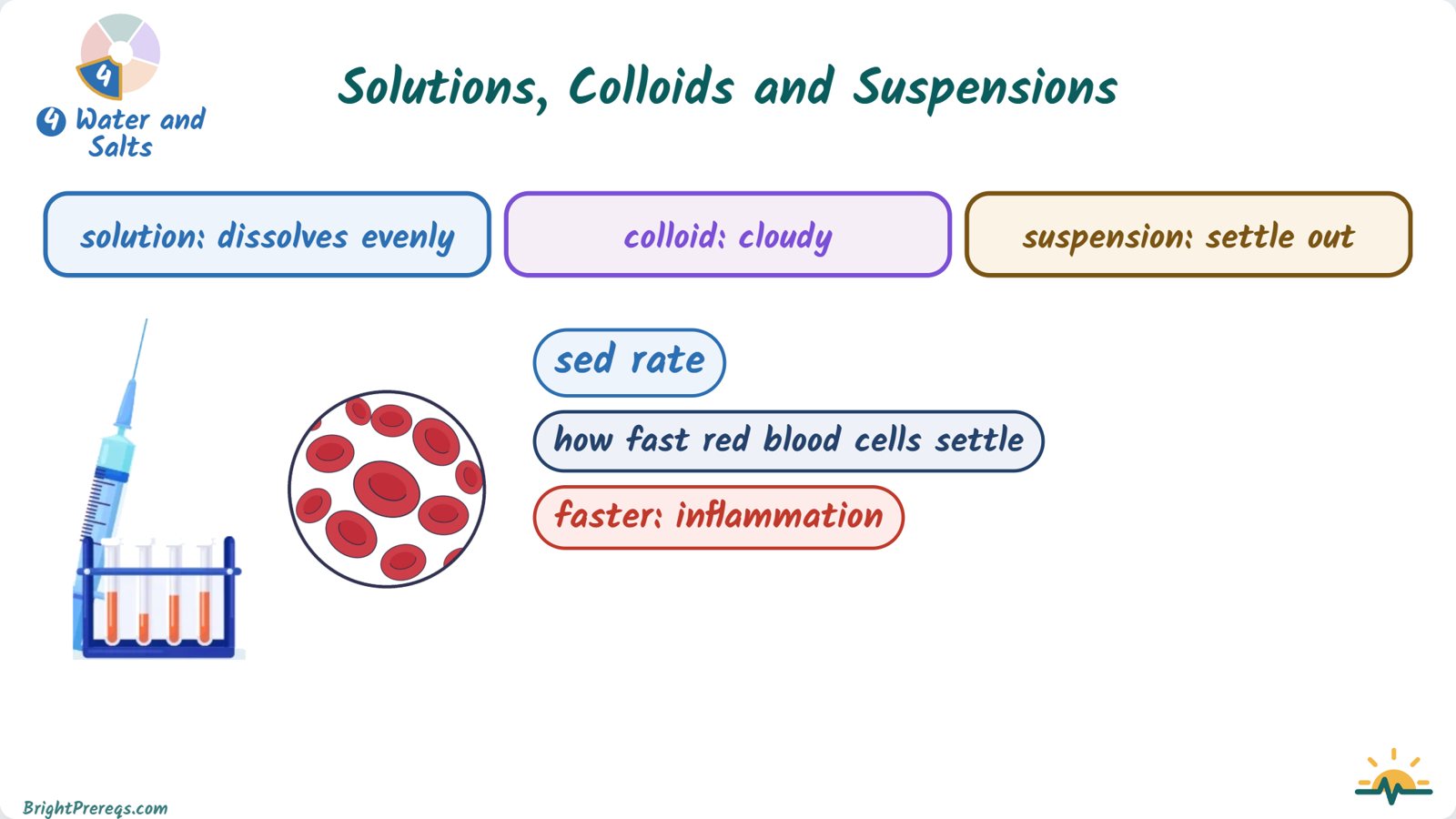
Water forms three kinds of liquid mixtures. In a solution, a substance dissolves evenly in a liquid, like sugar stirred into water. The liquid is the solvent; what dissolves is the solute.
Substances that dissolve in water are called hydrophilic, which means water-loving. Those that do not, like oil, are hydrophobic, which means water-fearing.
Concentration is how much of a solute is in a given space. Blood glucose is measured in milligrams per deciliter, and in a healthy adult averages about 100.
In a colloid, the particles are larger clumps, so the liquid looks cloudy, as milk does.
In a suspension, heavier particles float for a while, then settle out over time.
The sedimentation rate test, or sed rate, uses this. It measures how fast red blood cells settle in a tube. In some diseases the cells clump and settle faster, a sign of inflammation. Solution, colloid, suspension: dissolved evenly, cloudy, or settling out.
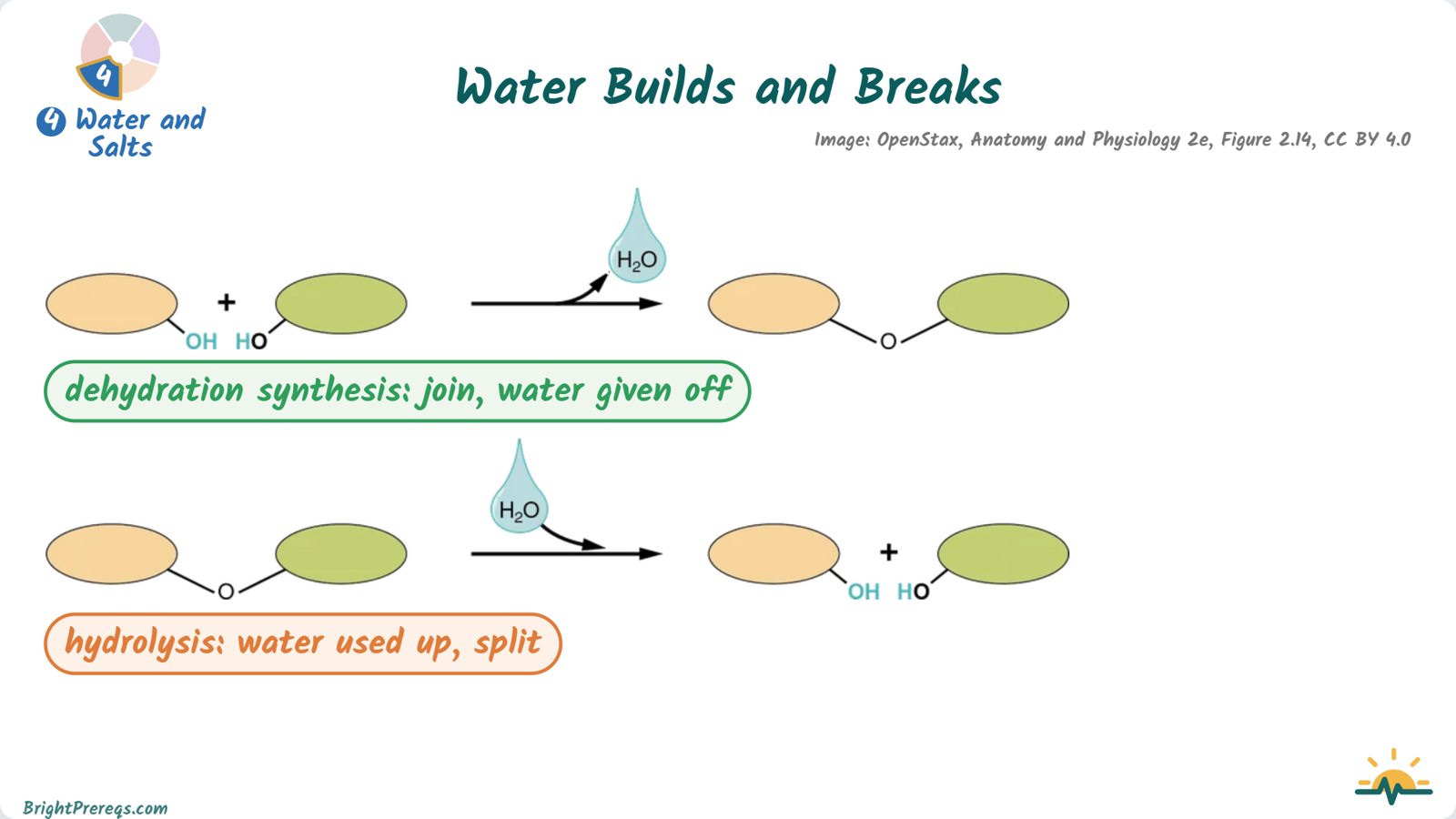
Water also takes part in reactions. In dehydration synthesis, two molecules join, and a molecule of water is given off.
In hydrolysis, the opposite happens: a molecule of water is used up, and a compound splits apart. Water out to build, water in to break: together these two reactions build and break down the body's large molecules.
A salt is a compound that breaks apart into ions when it dissolves in water. Table salt splits into sodium and chloride ions.
Those ions are electrolytes. They carry electric current, which nerve signals and muscle contractions depend on.
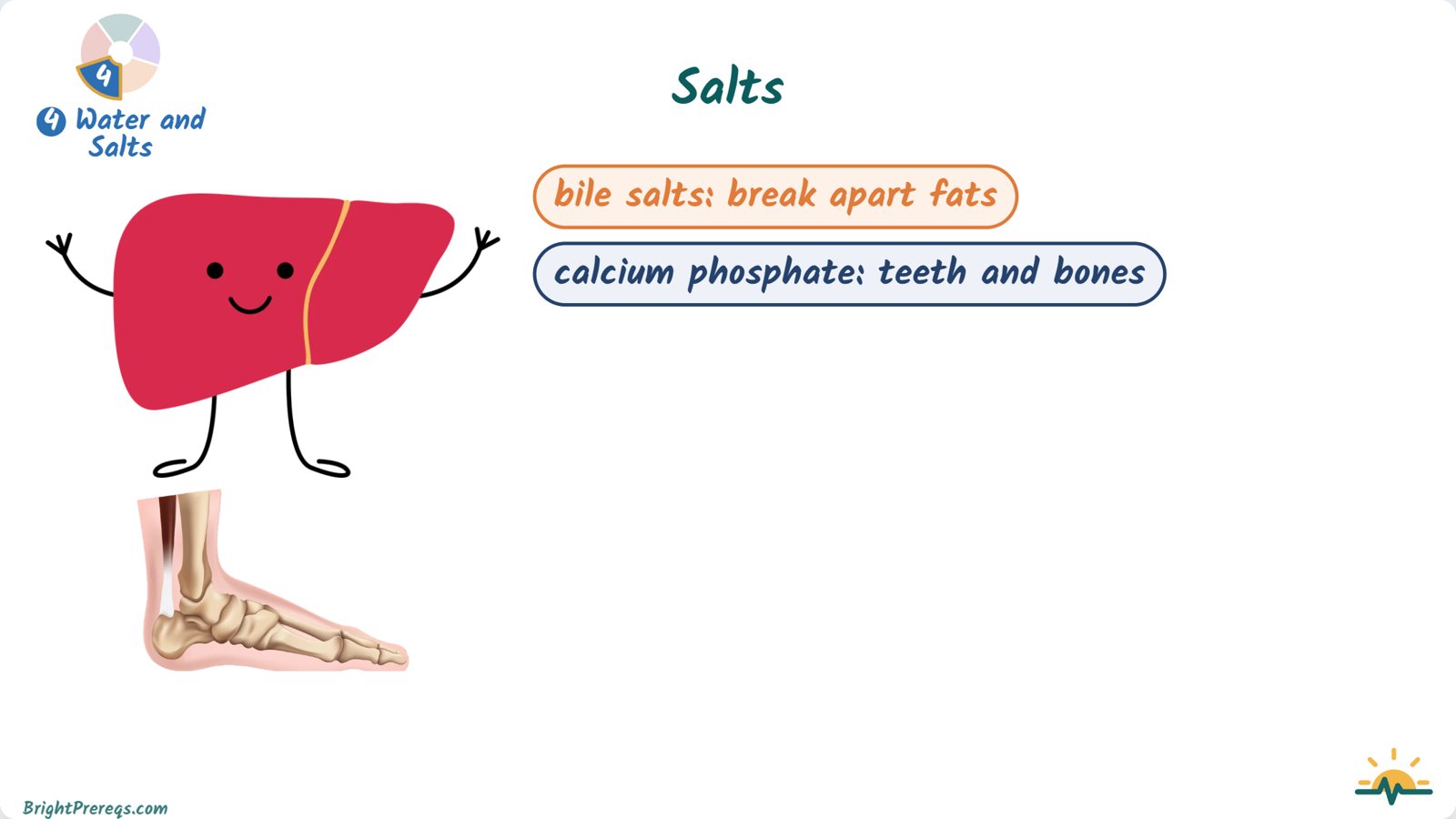
Other salts matter too. Bile salts from the liver help break apart fats in food, and calcium phosphate salts form the mineral part of teeth and bones.
Part 5: acids, bases and pH, and why blood pH must stay in a narrow range.
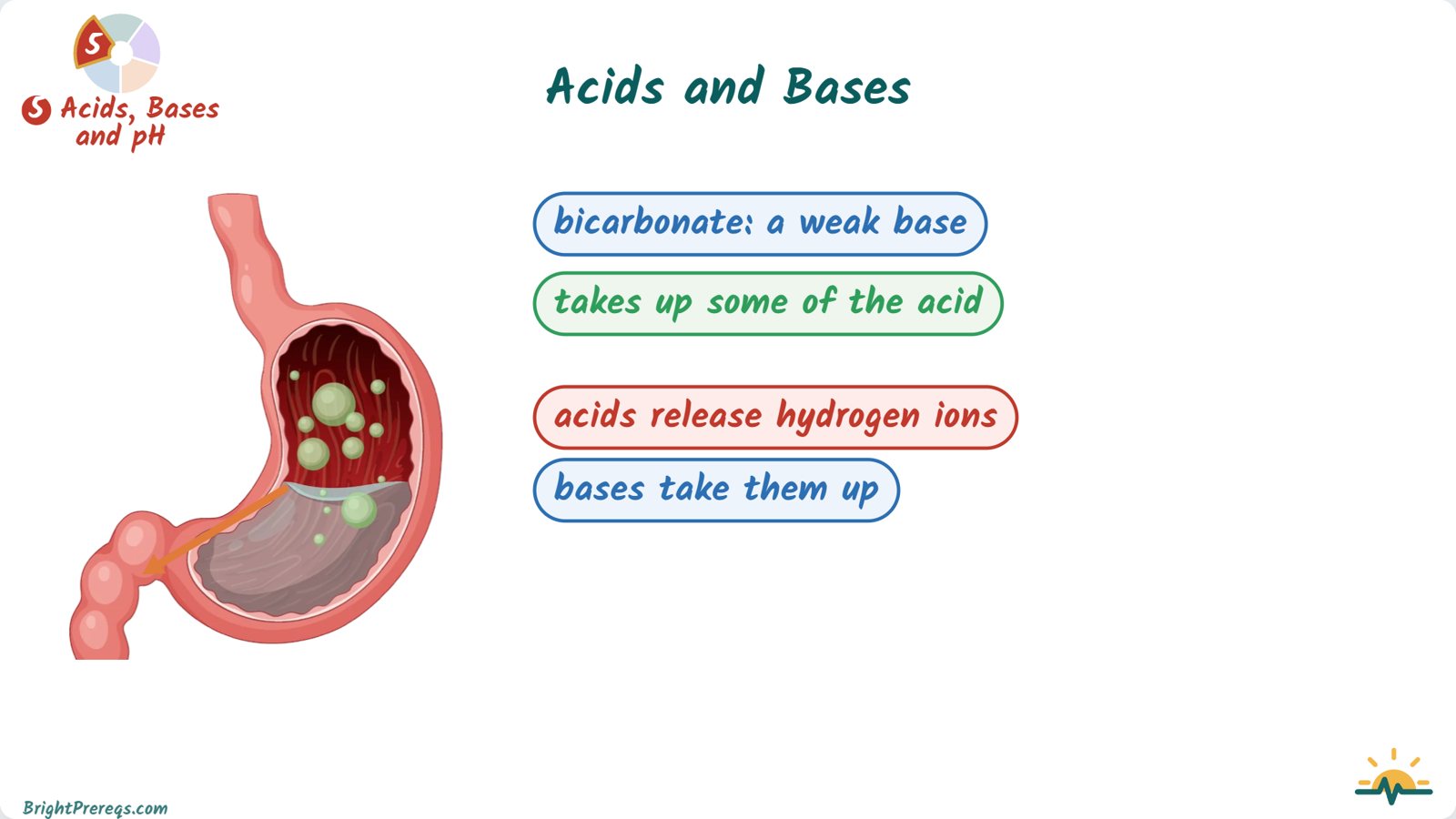
An acid releases hydrogen ions in water. A hydrogen ion is simply a proton, and it reacts very easily.
A strong acid releases all of its hydrogen ions. Hydrochloric acid, made by the stomach lining, is a strong acid that helps digest food and kills swallowed germs. A weak acid, like the vinegar in salad dressing, releases only some.
A base does the opposite. It takes up hydrogen ions from a solution, or releases hydroxide ions that join hydrogen ions to make water. Either way, the solution becomes less acidic.
Bicarbonate is a weak base. When acidic food leaves the stomach, bicarbonate takes up some of the acid, which would otherwise burn the small intestine. So acids release hydrogen ions, and bases take them up.
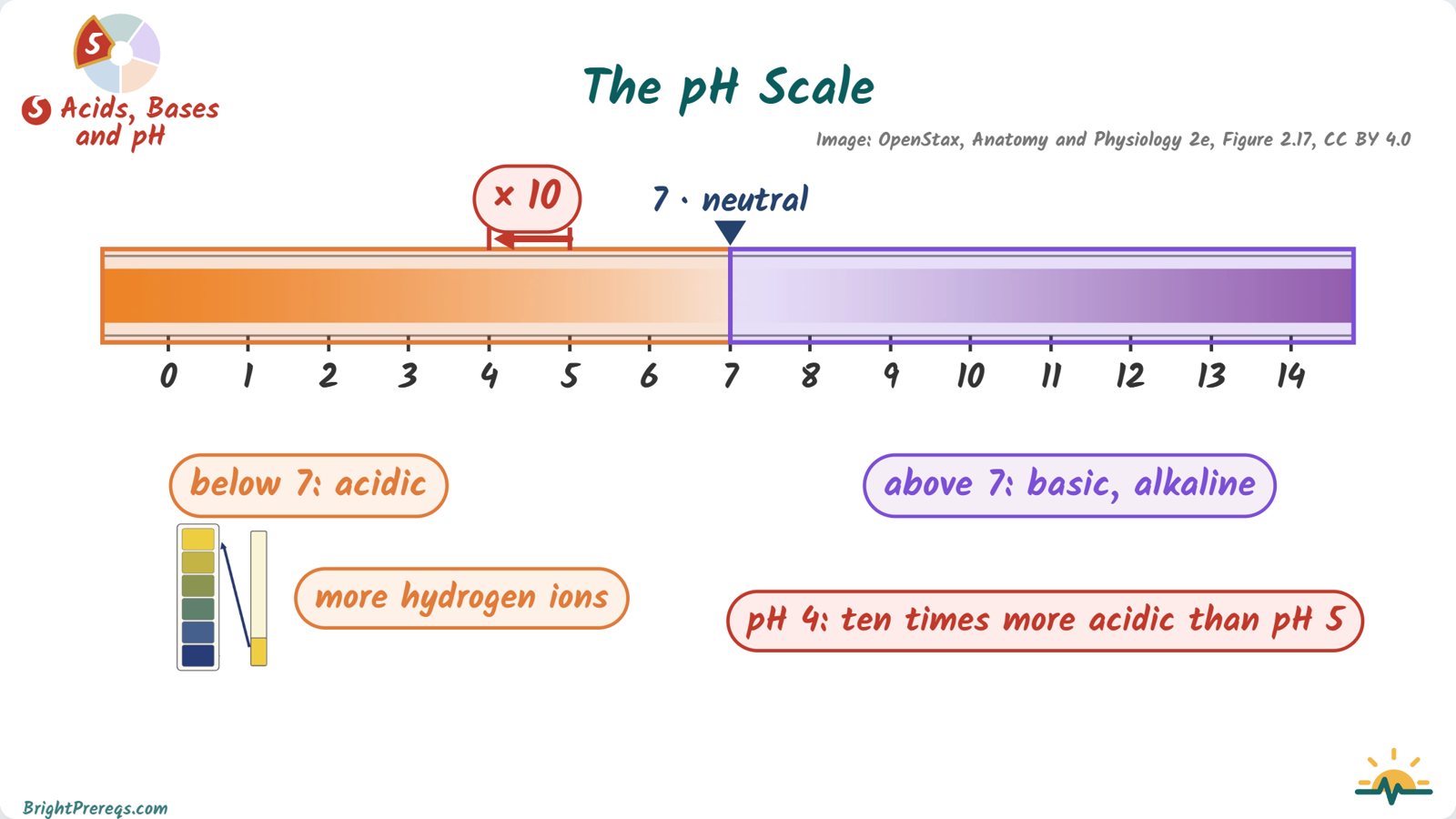
The pH shows how acidic or basic a solution is. The scale runs from 0 to 14, and 7 is neutral, like pure water.
Below 7 is acidic: the lower the number, the more hydrogen ions. Above 7 is basic, also called alkaline.
Each step on the scale is a tenfold change, because each step means ten times as many hydrogen ions. A pH of 4 is ten times more acidic than a pH of 5.
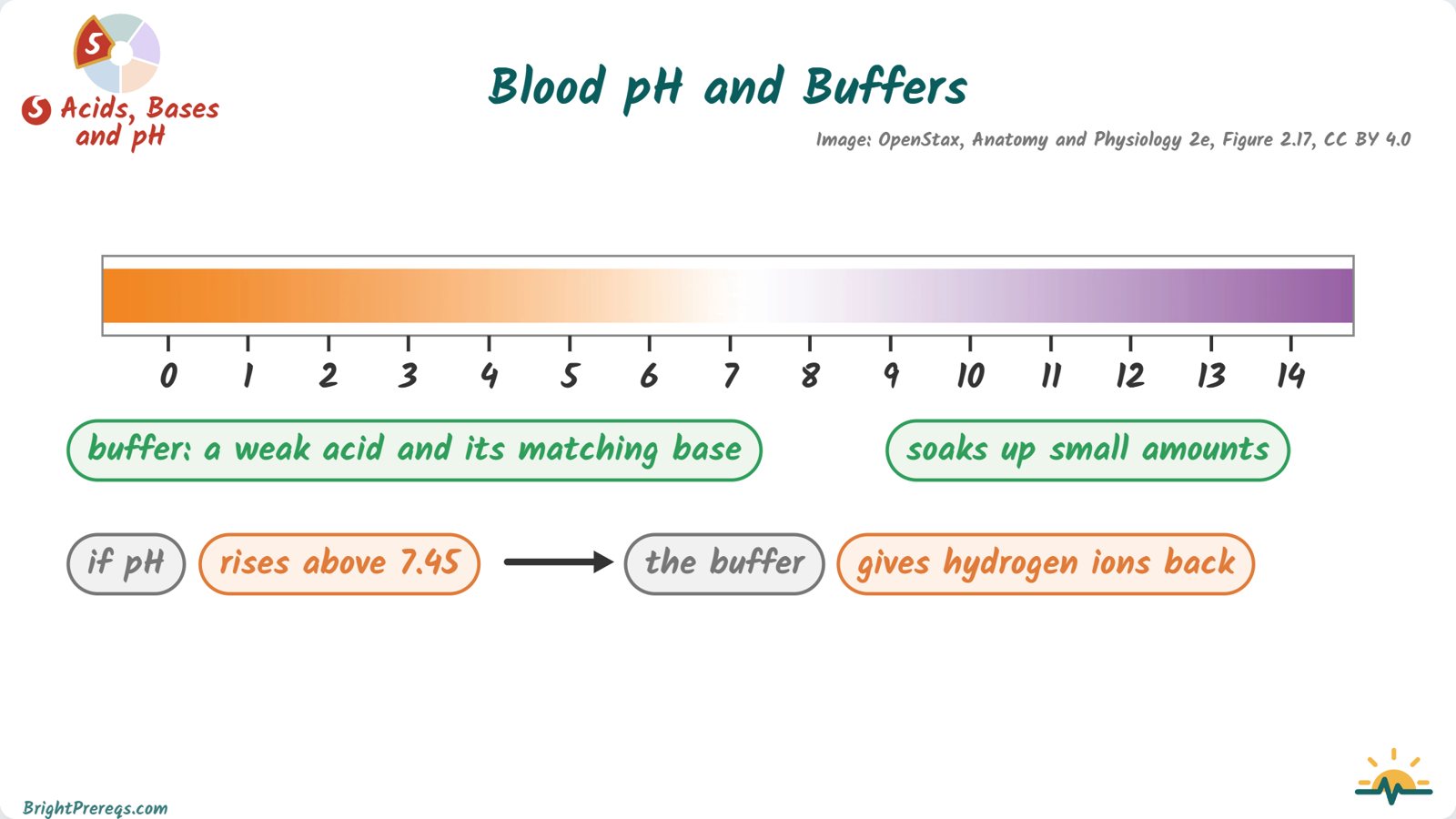
Blood is slightly basic. Its pH normally ranges from 7.35 to 7.45, and is usually given as 7.4. Being slightly basic lets blood soak up the acid from the carbon dioxide that the body's cells constantly release.
The range is narrow, and it matters. Blood that becomes too acidic or too alkaline can lead to life-threatening disorders.
The body keeps blood pH steady in three ways: breathing out carbon dioxide, removing chemicals in the urine, and buffers.
A buffer is a weak acid paired with its matching base, and it soaks up small amounts of acid or base. If pH falls below 7.35, the buffer binds the extra hydrogen ions. If pH rises above 7.45, it gives hydrogen ions back.
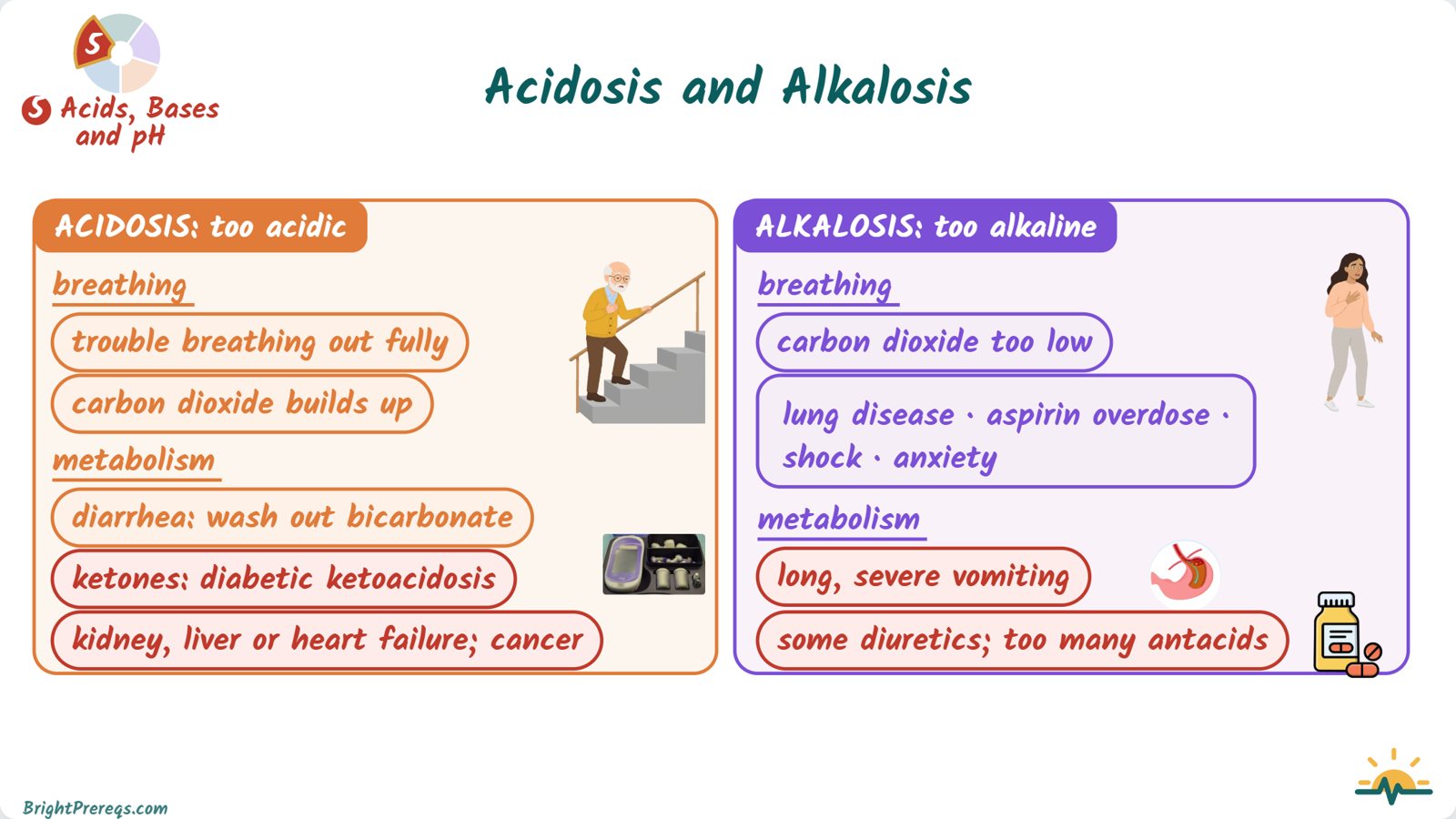
Blood that is too acidic is called acidosis. Breathing can cause it: trouble breathing out fully builds up carbon dioxide in the blood.
Metabolism can cause it too. Severe diarrhea can wash out bicarbonate. In poorly managed diabetes, acids called ketones build up in the blood, causing diabetic ketoacidosis.
Kidney failure, liver failure, heart failure and cancer can also lead to this metabolic acidosis.
Blood that is too alkaline is called alkalosis. Breathing can cause it: in respiratory alkalosis, carbon dioxide falls too low. Lung disease, an aspirin overdose, shock, and even ordinary anxiety can cause it.
Metabolism can cause it too: metabolic alkalosis often follows long, severe vomiting, which loses stomach acid. Some diuretics, and too many antacids, can cause it as well. Each one can start in breathing or in metabolism.
To recap. What is the body made of? Elements, mostly oxygen, carbon, hydrogen and nitrogen, as atoms of protons, neutrons and electrons.
Atoms join by bonds: ionic bonds hold opposite ions, covalent bonds share electrons, and hydrogen bonds are weak pulls.
Reactions break and make bonds. Building up stores energy, breaking down releases it, and enzymes lower the activation energy a reaction needs to start.
The body's reactions happen in water, up to 70 percent of an adult's weight. Water lubricates, cushions, soaks up heat and dissolves, and salts break into ions in it.
Why must blood pH stay narrow? Outside 7.35 to 7.45 lies acidosis, too acidic, or alkalosis, too alkaline, and both can be life-threatening. Buffers, breathing and the urine keep it in range. Losing stomach acid by long, severe vomiting turns it too alkaline.
The next video is Carbohydrates, Lipids, Proteins, Enzymes, Nucleic Acids and ATP.
The chapters this video teaches from, in OpenStax Anatomy and Physiology 2e and OpenRN General Anatomy & Physiology, free to read on BrightPrereqs.com.
Bright Beats Anatomy and Physiology, in textbook order.
Textbook pages cited: Anatomy and Physiology 2e, J. Gordon Betts et al., OpenStax, Rice University, CC BY-NC-SA 4.0, access for free at openstax.org; General Anatomy & Physiology, edited by Julia Brown, WisTech Open, CC BY-NC-SA 4.0.